
in History, Technology | September 9th, 2025 Leave a Comment
Ancient Rome never had an industrial revolution. Granted, certain historians have objected now and again to that once-settled claim, gesturing toward large heaps of pottery discovered in garbage dumps and other such artifacts clearly produced in large numbers. Still, the fact remains that Ancient Rome never had an industrial revolution of the kind that fired up toward the end of the eighteenth century, but not due to a complete absence of the relevant technology. As explained in the new Lost in Time video above, Romans had witnessed the power of steam harnessed back in the first century — but they dismissed it as a novelty, evidently unable to see its power to transform civilization.
That’s just one of a variety of examples of genuine high Roman technology featured in the video, many or all of which would seem implausible to the average viewer if inserted into a story set in ancient Rome.
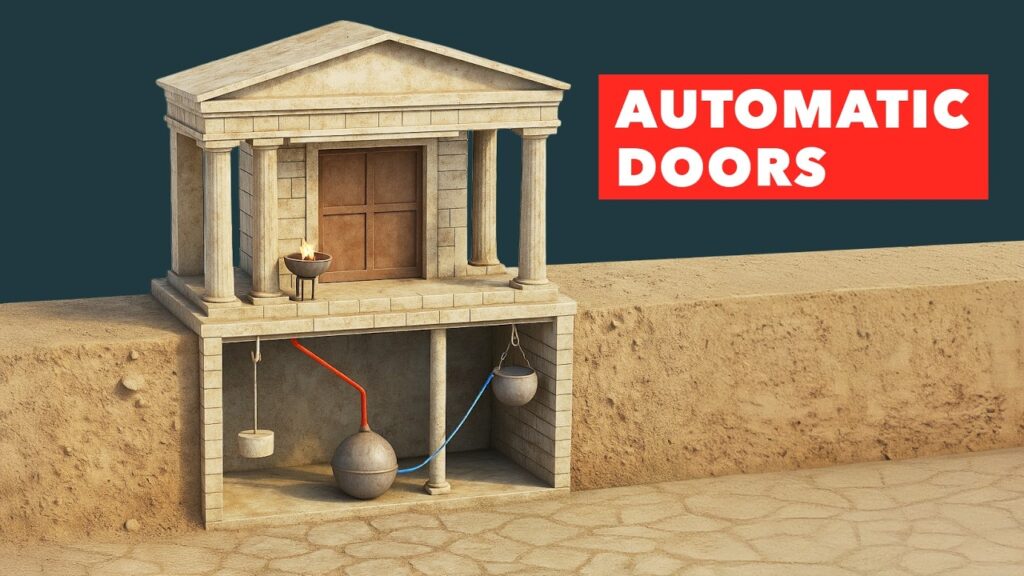
Take the set of automatic doors installed in a temple, triggered by a fire that heats an underground water tank, which in turn fills up a pot attached to a cable that — through a system of pulleys — throws them open. (When the fire cools down, the doors then shut again.) This was the work of the Greek-born inventor Hero of Alexandria, who would bear comparison in one sense or another with everyone from Rube Goldberg to Leonardo da Vinci.
It was also Hero who came up with that early steam turbine, called the aeolipile. He came along too late, however, to take credit for the “self-healing” Roman concrete previously much-featured here on Open Culture, the material of buildings like the Pantheon, “still the largest unreinforced concrete dome in the world.” Another invention highlighted in the video comes from Alexandria, but well before Hero’s time, and even before that of the Roman Empire itself: the accurate water clock engineered by Ctesibius, whose underlying design remained influential in the Roman era. Hydraulic power was also used in Roman mills, which made possible complex factory systems, even in a civilization that never reached an industrial revolution proper. And if a Roman factory worker got thirsty at break time, maybe he could drop a coin into one of Hero’s wine vending machines.
Related content:
How the Ancient Romans Built Their Roads, the Lifelines of Their Vast Empire
The Amazing Engineering of Roman Baths
The Roman Colosseum Deconstructed: 3D Animation Reveals the Hidden Technology That Powered Rome’s Great Arena
How Did Roman Aqueducts Work?: The Most Impressive Achievement of Ancient Rome’s Infrastructure, Explained
The Ancient Roman Dodecahedron: The Mysterious Object That Has Baffled Archaeologists for Centuries
Archaeologists Discover an Ancient Roman Snack Bar in the Ruins of Pompeii
Based in Seoul, Colin Marshall writes and broadcasts on cities, language, and culture. His projects include the Substack newsletter Books on Cities and the book The Stateless City: a Walk through 21st-Century Los Angeles. Follow him on the social network formerly known as Twitter at @colinmarshall.
by Colin Marshall | Permalink | Comments (0) |
We’re hoping to rely on our loyal readers rather than erratic ads. To support Open Culture’s educational mission, please consider making a donation. We accept PayPal, Venmo (@openculture), Patreon and Crypto! Please find all options here. We thank you! 
Be the first to comment.
Get the best cultural and educational resources on the web curated for you in a daily email. We never spam. Unsubscribe at any time.
FOLLOW ON SOCIAL MEDIA
Open Culture scours the web for the best educational media. We find the free courses and audio books you need, the language lessons & educational videos you want, and plenty of enlightenment in between.
©2006-2025 Open Culture, LLC.
All rights reserved.