
The White House is using government control over the economy in ways that overturn traditional Republican values
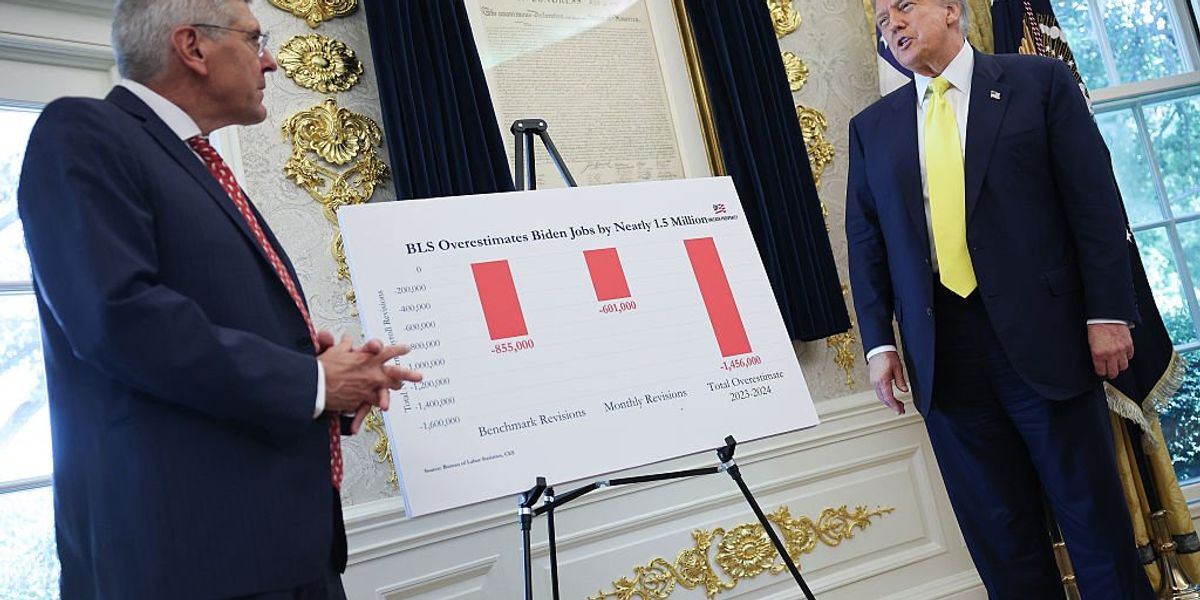
U.S. President Donald Trump discusses economic data with Stephen Moore (L), Senior Visiting Fellow in Economics at The Heritage Foundation, in the Oval Office on August 07, 2025 in Washington, DC.
For over 100 years, the Republican Party has stood for free-market capitalism and keeping the government’s heavy hand out of the economy. Government intervention in the economy, well, that’s what leaders did in the Soviet Union and communist China, not in the Land of Uncle Sam.
And then Donald Trump seized the reins of the Republican Party. Trump has dispensed with numerous federal customs and rules, so it’s not too surprising that he is now turning his administration into the most business-interventionist government ever in American history. Contrary to Adam Smith’s “invisible hand” in the economy, suddenly, the signs of the White House’s “visible hand” are everywhere.
Most recently, President Trump forced Intel, the struggling semiconductor company, to give the US government a nearly 10 percent stake in the company in return for nearly $9 billion in government funding from the Biden administration’s 2022 CHIPS Act. Trump had previously criticized that law, which was part of an industrial policy intended to boost semiconductor manufacturers. Previously, Trump had called for the resignation of Intel’s new chief executive, Lip-Bu Tan, based on vague allegations that Tan had invested in Chinese technology companies that US officials say have links to China’s military (Tan is an American citizen who was born in Malaysia and raised in Singapore).
A week before, the Trump administration had cut another revenue-sharing agreement with the world’s largest semiconductor company, Nvidia, whose chips are critical to the artificial intelligence boom. Oddly, last April, the president had barred Nvidia from exporting its highest-grade H20 chips to China. But after Nvidia agreed to cough up 15 percent of its revenues to the government, Trump relaxed those export rules even though doing so appears to violate the constitutional ban on taxing exports. These were shakedown operations, pure and simple, and President Trump seems to be pretty good at them.
In fact, a month before, in mid-June, the president shook down US Steel and didn’t allow Japanese company Nippon Steel’s proposed acquisition of it to go through. For over a year, during his presidential campaign, Trump had spoken forcefully against this merger. Suddenly, he reversed and approved the merger, once Nippon agreed to allow the Trump administration to receive a “golden share” of the company. More than a regular share, it gives the president of the United States permanent and extraordinary influence over the company, including significant sway over its board and veto power over a wide array of company actions. Activities requiring the president’s approval include closing or idling plants before agreed-upon time frames and transferring production or jobs outside the US. The United Steelworkers union, which saw many of its rank-and-file members support Donald Trump for president in 2024, is feeling betrayed.
Last week, Trump boasted on social media that he would “make deals like that for our Country all day long.” In a recent CNBC interview, Trump’s director of the National Economic Council, economist Kevin Hassett, said that the administration is looking to gain stock equity in other companies, including military-related companies. So the White House is clearly not done, as it has announced the creation of a loyalty scorecard that rates 553 companies and trade associations on how well they have supported President Trump's efforts. So what Trump is doing with these companies could soon become a template for dozens of US companies in which the White House demands its golden share.
Firing of many economic leaders — illegally
President Trump has pressed both his thumbs on the scales of the economy in other ways. For example, he has attempted to fire any economic leaders who don’t agree with him, even those who are constitutionally protected from presidential meddling.
Most recently, he has attempted to fire Lisa Cook, a member of the Federal Reserve’s Board of Governors, which oversees important functions such as establishing interest rates, money supply, inflation, and key components of national financial policy. If successful, this act could seriously undermine the trust and confidence of investors and policymakers around the world, since it would demonstrate that the Federal Reserve is no longer independent of the president’s whims and desires, as the Fed was established to be in 1913.
Just recently, a federal appeals court reinstated a commissioner of the Federal Trade Commission that Trump had illegally fired, the court ruling that a commissioner can only be removed for "inefficiency, neglect of duty, or malfeasance in office." But Trump fired her without giving any reason at all.
He did the same thing previously when he fired a commissioner of the National Labor Relations Board, who was then reinstated by a federal district court. Then the US Supreme Court temporarily stayed the reinstatement while the top court decides the case sometime in the future. Even when courts reverse the president’s clearly illegal decisions, the situation is still intimidating for the harassed commissioners.
So President Trump – the government’s chief executive – is regularly inserting himself into the very heart of the US economy in state-sponsored ways that are alien to traditional Republican values and principles. This signals a huge philosophical shift, not only by Trump but by the Republican Party. Instead of being the “conservative” party, now the White House has fully embraced a kind of “neo-socialist” radicalism combined with an adoption of Silicon Valley’s militant mindset of “move fast and break things” and “do it now and apologize later” (perhaps influenced initially by Tesla CEO Elon Musk’s DOGE, before Trump and Musk’s high-profile falling out).
What if Democrats did the same?
The thing that is doubly ironic is that if a Democratic president did this – engaged in a shakedown of top companies for a government stake in their company, illegally fired top commissioners overseeing the economy, and more – GOP lawmakers and politicians would have been mounting a furious criticism over “government interference.” If a Democratic president had run up the debt to $37 trillion, started a trade war with unpredictable tariffs, fired experts and commissioners who disagreed over his policies, Republicans would have attacked Democrats as “closet socialists.” The GOP House majority may well have drawn up articles of impeachment against a Democratic president.
So President Trump is overturning 50 years of Republican orthodoxy, since President Ronald Reagan said “government is the problem,” and GOP leaders insisted on government playing as small a role as possible in the economy. Now, Trump is partially nationalizing the economy.
Investor-in-chief
President Trump, along with family members, is engaging in other unprecedented practices that impact the economy and raise important issues about conflicts of interest. For years, Donald Trump and his sons, Don Jr and Eric, showed no interest and were even dismissive of artificial intelligence technologies as well as cryptocurrencies. As recently as 2021, President Trump described cryptocurrency as a “scam.” But suddenly, Trump says he wants to make the United States the "crypto capital of the world."
Why the sudden volte-face? Simple. The Trump family has discovered that “there is gold in them thar hills.” They have launched a family investment strategy beyond their traditional real estate and hotels portfolio, figuring out how to make a lot of money — billions of dollars — in AI and crypto investments.
A few weeks after the White House loosened the Biden administration’s AI regulations, Don Jr. and Eric Trump invested a lot of money in a new company, American Data Centers Inc., which aims to build high-performance computing infrastructure to support AI, cloud computing, and cryptocurrency mining. This investment positions the Trump family to profit richly from government backing for targeted AI companies, including data center expansion. CBS reports that the Trump family's net worth has increased by $2.9 billion thanks to its various tech-related investments, which now reportedly represent nearly 40% of Donald Trump’s personal net worth. Trump, the Hotel King, is now the Crypto King.
When you combine the Trump family’s self-interest with global tariffs and all the other factors outlined above, it adds to the overall picture that the Trump family is trying to exert a heavy-handed and self-interested role in fundamentally remaking the US economy. President Trump is steeped in overlapping public and private roles like no previous president, with the potential for ethics breaches and even corruption at every turn.
Steven Hill was policy director for the Center for Humane Technology, co-founder of FairVote and political reform director at New America. You can reach him on X @StevenHill1776.
For over 100 years, the Republican Party has stood for free-market capitalism and keeping the government’s heavy hand out of the economy. Government intervention in the economy, well, that’s what leaders did in the Soviet Union and communist China, not in the Land of Uncle Sam.
And then Donald Trump seized the reins of the Republican Party. Trump has dispensed with numerous federal customs and rules, so it’s not too surprising that he is now turning his administration into the most business-interventionist government ever in American history. Contrary to Adam Smith’s “invisible hand” in the economy, suddenly, the signs of the White House’s “visible hand” are everywhere.
Most recently, President Trump forced Intel, the struggling semiconductor company, to give the US government a nearly 10 percent stake in the company in return for nearly $9 billion in government funding from the Biden administration’s 2022 CHIPS Act. Trump had previously criticized that law, which was part of an industrial policy intended to boost semiconductor manufacturers. Previously, Trump had called for the resignation of Intel’s new chief executive, Lip-Bu Tan, based on vague allegations that Tan had invested in Chinese technology companies that US officials say have links to China’s military (Tan is an American citizen who was born in Malaysia and raised in Singapore).
A week before, the Trump administration had cut another revenue-sharing agreement with the world’s largest semiconductor company, Nvidia, whose chips are critical to the artificial intelligence boom. Oddly, last April, the president had barred Nvidia from exporting its highest-grade H20 chips to China. But after Nvidia agreed to cough up 15 percent of its revenues to the government, Trump relaxed those export rules even though doing so appears to violate the constitutional ban on taxing exports. These were shakedown operations, pure and simple, and President Trump seems to be pretty good at them.
In fact, a month before, in mid-June, the president shook down US Steel and didn’t allow Japanese company Nippon Steel’s proposed acquisition of it to go through. For over a year, during his presidential campaign, Trump had spoken forcefully against this merger. Suddenly, he reversed and approved the merger, once Nippon agreed to allow the Trump administration to receive a “golden share” of the company. More than a regular share, it gives the president of the United States permanent and extraordinary influence over the company, including significant sway over its board and veto power over a wide array of company actions. Activities requiring the president’s approval include closing or idling plants before agreed-upon time frames and transferring production or jobs outside the US. The United Steelworkers union, which saw many of its rank-and-file members support Donald Trump for president in 2024, is feeling betrayed.
Last week, Trump boasted on social media that he would “make deals like that for our Country all day long.” In a recent CNBC interview, Trump’s director of the National Economic Council, economist Kevin Hassett, said that the administration is looking to gain stock equity in other companies, including military-related companies. So the White House is clearly not done, as it has announced the creation of a loyalty scorecard that rates 553 companies and trade associations on how well they have supported President Trump's efforts. So what Trump is doing with these companies could soon become a template for dozens of US companies in which the White House demands its golden share.
Firing of many economic leaders — illegally
President Trump has pressed both his thumbs on the scales of the economy in other ways. For example, he has attempted to fire any economic leaders who don’t agree with him, even those who are constitutionally protected from presidential meddling.
Most recently, he has attempted to fire Lisa Cook, a member of the Federal Reserve’s Board of Governors, which oversees important functions such as establishing interest rates, money supply, inflation, and key components of national financial policy. If successful, this act could seriously undermine the trust and confidence of investors and policymakers around the world, since it would demonstrate that the Federal Reserve is no longer independent of the president’s whims and desires, as the Fed was established to be in 1913.
Just recently, a federal appeals court reinstated a commissioner of the Federal Trade Commission that Trump had illegally fired, the court ruling that a commissioner can only be removed for "inefficiency, neglect of duty, or malfeasance in office." But Trump fired her without giving any reason at all.
He did the same thing previously when he fired a commissioner of the National Labor Relations Board, who was then reinstated by a federal district court. Then the US Supreme Court temporarily stayed the reinstatement while the top court decides the case sometime in the future. Even when courts reverse the president’s clearly illegal decisions, the situation is still intimidating for the harassed commissioners.
So President Trump – the government’s chief executive – is regularly inserting himself into the very heart of the US economy in state-sponsored ways that are alien to traditional Republican values and principles. This signals a huge philosophical shift, not only by Trump but by the Republican Party. Instead of being the “conservative” party, now the White House has fully embraced a kind of “neo-socialist” radicalism combined with an adoption of Silicon Valley’s militant mindset of “move fast and break things” and “do it now and apologize later” (perhaps influenced initially by Tesla CEO Elon Musk’s DOGE, before Trump and Musk’s high-profile falling out).
What if Democrats did the same?
The thing that is doubly ironic is that if a Democratic president did this – engaged in a shakedown of top companies for a government stake in their company, illegally fired top commissioners overseeing the economy, and more – GOP lawmakers and politicians would have been mounting a furious criticism over “government interference.” If a Democratic president had run up the debt to $37 trillion, started a trade war with unpredictable tariffs, fired experts and commissioners who disagreed over his policies, Republicans would have attacked Democrats as “closet socialists.” The GOP House majority may well have drawn up articles of impeachment against a Democratic president.
So President Trump is overturning 50 years of Republican orthodoxy, since President Ronald Reagan said “government is the problem,” and GOP leaders insisted on government playing as small a role as possible in the economy. Now, Trump is partially nationalizing the economy.
Investor-in-chief
President Trump, along with family members, is engaging in other unprecedented practices that impact the economy and raise important issues about conflicts of interest. For years, Donald Trump and his sons, Don Jr and Eric, showed no interest and were even dismissive of artificial intelligence technologies as well as cryptocurrencies. As recently as 2021, President Trump described cryptocurrency as a “scam.” But suddenly, Trump says he wants to make the United States the "crypto capital of the world."
Why the sudden volte-face? Simple. The Trump family has discovered that “there is gold in them thar hills.” They have launched a family investment strategy beyond their traditional real estate and hotels portfolio, figuring out how to make a lot of money — billions of dollars — in AI and crypto investments.
A few weeks after the White House loosened the Biden administration’s AI regulations, Don Jr. and Eric Trump invested a lot of money in a new company, American Data Centers Inc., which aims to build high-performance computing infrastructure to support AI, cloud computing, and cryptocurrency mining. This investment positions the Trump family to profit richly from government backing for targeted AI companies, including data center expansion. CBS reports that the Trump family's net worth has increased by $2.9 billion thanks to its various tech-related investments, which now reportedly represent nearly 40% of Donald Trump’s personal net worth. Trump, the Hotel King, is now the Crypto King.
When you combine the Trump family’s self-interest with global tariffs and all the other factors outlined above, it adds to the overall picture that the Trump family is trying to exert a heavy-handed and self-interested role in fundamentally remaking the US economy. President Trump is steeped in overlapping public and private roles like no previous president, with the potential for ethics breaches and even corruption at every turn.
Steven Hill was policy director for the Center for Humane Technology, co-founder of FairVote and political reform director at New America. You can reach him on X @StevenHill1776.
Rising debt, stagnant wages, and soaring costs leave families living paycheck to paycheck in 2025.
In the late 1970s, my mom worked as a nurse and became the family's breadwinner after my dad developed serious heart disease. His doctors told him to avoid stress, even driving, for fear it would be fatal. Yet on her single income, we managed what was then considered a solidly middle-class life. Stability was assumed, even if one parent couldn’t work.
That assumption has vanished. Today, surveys show that roughly half to two-thirds of Americans live paycheck to paycheck (People’s Policy Project). A stricter Bank of America analysis finds that about one in four households spends nearly all their income on essentials (Axios). Whether the number is one-in-two or one-in-four, millions of Americans are financially on the edge.
Credit card delinquencies are at a 13-year high, and even routine expenses—rent, groceries, childcare—are enough to push families to the brink. The lived reality of millions of households isn’t prosperity—it’s precariousness. Economist Hyman Minsky warned that booms don’t eliminate risk—they breed it. His financial instability hypothesis (Institute for New Economic Thinking) shows how debt piles up until even small shocks can trigger a crisis. By that measure, 2025 looks like a country skating on thin ice. And despite the White House’s boasts of a “booming economy,” the cracks are showing everywhere.
What once sustained a family on one income now falls short. In 2025, the math simply doesn’t add up. The Census Bureau reports that the median household income is about $74,500, but the baseline cost of a “normal” middle-class life—mortgage, car, childcare, healthcare—can easily reach $120,000 to $140,000 a year in many metro areas. Families are left plugging the gap with debt or scaling back until stability disappears.
Warning signs are piling up. Credit card delinquencies are at their highest level in 13 years, as households lean on plastic to cover rising rent, insurance, and grocery bills. The share of income consumed by essentials keeps rising, leaving little room for savings or emergencies.
Even in cities once considered affordable, the squeeze is undeniable. In places like Cleveland and St. Louis, median home prices now hover near $300,000—requiring $75,000–$100,000 in income just to avoid being house poor, a threshold already beyond many families. Families aren’t living extravagantly—they’re trapped in an economic system where wages lag behind the costs of essentials, leaving millions running faster just to stay in place.
If households are stuck, much of the reason lies in debt. Mortgages, auto loans, and credit cards eat into paychecks before families can save. Medical bills add to the burden, with insurance premiums up nearly 50% in the past decade and deductibles climbing faster than wages.
The generational squeeze is especially stark. For younger Americans, tuition at public universities has more than tripled since 1980, leaving over 43 million people owing $1.7 trillion in student loans. What was once a ladder into the middle class now delays homeownership, family formation, and savings. Millions of young adults begin life under water.
At the other end of the age spectrum, older Americans face a precarious retirement. Social Security and Medicare remain the pillars of security, but both are under pressure. Trump’s proposal to eliminate taxes on Social Security benefits would blow a $1.6–$1.8 trillion hole in the trust funds, pushing insolvency up to 2032 for Social Security and 2030 for Medicare. That means steep benefit cuts just as Baby Boomers age into retirement.
Meanwhile, long-term care can cost $50,000 to $100,000 a year—far beyond what most retirees have saved.
Across generations, debt has become the silent architecture of American life. Young adults start adulthood burdened, middle-aged families juggle housing and medical bills, and seniors fear outliving their savings. Fragility isn’t confined to Wall Street—it runs through America’s households.
Households aren’t the only ones squeezed. Small businesses—the backbone of many communities—are freezing in place too. The U.S. Chamber of Commerce reports that confidence has dropped to levels not seen since early 2024. Owners cite inflation and tight credit, but the deeper issue is uncertainty.
Trump’s trade wars, tariff threats, and Congress’s reliance on stopgap budgets make long-term planning nearly impossible. Unlike large corporations, small businesses don’t have legal teams or lobbyists to navigate shifting tax codes and regulatory whiplash.
Instead of hiring or expanding, many are sitting on their hands, waiting for clarity that never comes. Scaled up across the economy, that caution translates into weaker growth, fewer jobs, and less innovation—the very conditions that deepen household insecurity.
When both families and small businesses are stuck in survival mode, the broader economy becomes fragile by design. This is exactly what Minsky meant: what looks like stability is often brittleness in disguise.
Taken together, the evidence points to an economy far less stable than the White House boasts. Families are buried in debt, young adults begin life under water, retirees face shrinking safety nets, and small businesses are too cautious to invest. The result isn’t resilience—it’s fragility.
When I think back to my childhood, what stands out is how one nurse’s salary was enough to keep a roof over our heads and food on the table. That sense of stability—the assumption that middle-class life was secure—was once the foundation of American society. Today, it has crumbled. What my family could manage with one income now takes two, and even then, the math rarely works.
This article is the first in a series exploring how Trump’s economic agenda is destabilizing the country. Here we’ve traced the household and community-level squeeze. In the next piece, we’ll move up the ladder—to financial markets, Wall Street excess, and executive overreach—before concluding with recommendations to restore stability. Those reforms will address issues like affordable housing, the cost of education and healthcare, and policies that could restore predictability for families and businesses alike.
For now, one point is clear: America is living on a fragile foundation. The cracks are already visible. Whether they widen into a full-blown crisis depends not just on markets, but on whether our leaders—and voters—still have the will to fight for a middle class that can thrive again.
In an aerial view, a container ship arrives at the Port of Oakland on Aug. 1, 2025, in Oakland, California.
On May 1, 2003, George W. Bush announced, “Major combat operations in Iraq have ended.” He was standing below a giant banner that read, “Mission Accomplished.” At the risk of inviting charges of understatement, subsequent events didn’t cooperate. But it took a while for that to be widely accepted.
We’re in a similar place when it comes to President Trump’s experiment with a new global trading order.
“Tariffs are making our country Strong and Rich!!!” proclaims Trump, making him not only the first Republican president in living memory to brag about raising taxes on Americans, but also the first to insist that raising taxes on Americans makes us richer.
MAGA’s mission-accomplished groupthink relies primarily on three arguments.
The first is that Trump has successfully concluded a slew of beneficial trade deals. The truth is that some of those deals are simply “frameworks” that will take a long time to be ironed out. But Trump got the headlines he wanted.
The second argument is a kind of populism-infused sleight of hand. The “experts” — their scare quotes, not mine — are wrong once again.
The White House social media account crows, “In April, ‘experts’ called tariffs ‘the biggest policy mistake in 95 years.’ By July, they generated OVER $100 BILLION in revenue. Facts expose the haters: tariffs WORK. Trust in Trump.”
But the high-fivers are leaving things out. The most-dire predictions of economic catastrophe were based on the scheme Trump announced on April 2, a.k.a. “Liberation Day.” Trump quickly backed off that plan (“chickened out” in Wall Street parlance ) in response to a bond and stock market implosion.
Saying the experts were wrong under those circumstances is like saying experts opposed to defenestration were wrong when they successfully convinced a man not to jump out a window.
The third argument, made by the White House and many others — that tariffs are working because they’re raising money — is a response to a claim no one made. To my knowledge, no expert claimed tariffs wouldn’t raise money.
The estimates of these revenues from Trump world are stratospheric. Commerce Secretary Howard Lutnick expects somewhere between $700 billion and $1 trillion per year. Last month, the government collected $29 billion. It’s likely this number will significantly increase as more tariffs come online and businesses run down the inventory they stockpiled earlier this year in anticipation of more tariffs to come.
Normally, Republicans don’t exult over massive revenues from tax hikes. But Trump’s defenders get around this problem by insisting that money is “pouring” and “flowing” into America from someplace else.
It’s true that tariff revenue is pouring into the Treasury, but that money is coming out of American bank accounts, because American importers pay the tariff. Even Treasury Secretary Scott Bessent cannot deny this when pressed.
So yes, tariffs are “working” the way they’re supposed to; the problem is Trump thinks tariffs work differently than they do.
It’s possible some foreign exporters might lower prices to maintain market share, and some American businesses might absorb the costs — for now — to avoid sticker shock for inflation-beleaguered consumers, but what revenue is generated still comes from Americans. Ultimately it means higher prices paid here, reduced profits for businesses here or reduced U.S. trade overall.
Sometimes, when pressed, defenders of the administration will concede the true source of the revenues, but then they say the pain is necessary to force manufacturers and other businesses to build and produce in the United States. It’s backdoor industrial policy masquerading as trade policy.
That, too, might “work.” But all of this will take time, no matter what. And, if it works, that will have costs, too. Manufacturing in America is more expensive — that’s why we manufacture so much stuff abroad in the first place. If this “reshoring” happens, our goods will be more expensive, and less money will “pour in” from tariffs.
It’s difficult to exaggerate how well-understood all of this was on the American right until very recently. But the need to grab any argument available to declare Trump’s experiment a success has a lot of people not only abandoning their previous dogma but leaping to the conclusion that the dogma was wrong all along.
Maybe it was, though I don’t think so. The evidence so far suggests that problems are looming. The dollar is weakening. Prices continue to rise. The job market is reeling. The stock market (an unreliable metric, according to MAGA, when it plummeted after Liberation Day) is holding on, thanks to tech stocks. The truth is we won’t have real evidence for a while.
It’s worth remembering that Americans don’t live by headlines and press releases and they don’t live in the macro economy either. Declaring “Mission Accomplished” for the macro economy won’t convince people they’re better off in their own micro-economies when they’re not.
Jonah Goldberg is editor-in-chief of The Dispatch and the host of The Remnant podcast. His Twitter handle is @JonahDispatch.
Tariff ‘Mission Accomplished’ Hype Is Just That was originally published by the Tribune Content Agency and is republished with permission.
AI-driven "surveillance pricing" hides the price increases from stressed-out parents.
For families with school children, the summer is coming to a close, and it’s time to start thinking about—school shopping! New clothes, shoes, daypacks, and school supplies are topmost of mind, making sure your little Einsteins and Rembrandts are ready to take on the new school year.
But this year, it’s coming with a twist—not only are prices higher in the stores and online, but the price increases are seemingly “invisible” due to deceptive uses of new technologies and what is known as “surveillance pricing.”
While families will spend an average of $858 on school supplies, according to the National Retail Federation, a report by Intuit Credit Karma found that 39% of parents said they can’t afford back-to-school shopping this year. 44% of parents said they plan to take on debt to purchase school supplies to help their child “fit in,” up from 34% in 2024. More than half (54%) of parents plan to sacrifice necessities, such as groceries, to ensure their kids have what they need for the school year.
Parents aren’t imagining things. Recent data showing core inflation for July from the Consumer Price Index was the highest it’s been since early 2025. And the recent data for the Producer Price Index climbed to 0.9%, much higher than expected, and the highest since the sky-high inflation in 2022. Many are blaming President Donald Trump’s tariffs for the price increases; however, most of the tariffs didn’t go into effect until early August. Economists generally think shoppers have yet to feel the full effect of Trump's topsy turvy tariff policy.
So the exact cause of these price increases remains murky, even as they chip away at families’ sense of economic security and add to the anxiety that parents are feeling.
The evidence of stressed-out parents is more than statistical. Frustrated and increasingly angry people are venting their feelings by posting online videos of themselves shopping in stores.
One mother pushing her cart down the aisle in Target noticed something strange—Target had covered all of its prices from two days before and jacked up the prices by 10-20%. She narrated her stewing anger on TikTok as she rolled down the aisle, saying, “They are raising prices on everything in their store, and they’re just covering it up with little white tags…Are you guys mad yet?”
Another Target shopper videoed himself finding torn-off prices amidst price increases by as much as 75%, while Walmart shoppers also found prices removed and a markup of 60%.
Such a lack of transparency and understanding around price increases only adds to shoppers’ frustration levels.
With posted price tags disappearing, it has created an opening for retailers to introduce another new technology that has insidious potential. It’s called “dynamic pricing,” which is a form of AI– driven automated pricing, combining digital surveillance of consumers and their spending habits with relentless corporate profit-seeking. In its worst form, this has resulted in complaints over price gouging.
With dynamic pricing, stores can change electronic prices instantaneously, allowing them to deploy strategies like “surge pricing,” when prices increase during a window of increased consumer demand. Surge pricing has already been used by Uber, hotels, and airlines. Hundreds of horror stories exist from when Uber’s fare prices suddenly zoomed higher during times of peak demand—such as during a mass shooting in 2022, when a suspect shot 10 people in a train car during morning rush hour, and those using Uber and Lyft to flee the scene found their regular prices quadrupling to as high as $100.
Now this kind of dynamic pricing is coming to retail stores like Walmart, Target, and others, led by Amazon. Proponents of dynamic pricing claim that it allows precision based on various factors, such as current market demand, seasonal fluctuations, and supply changes. Product prices continuously adjust—sometimes within minutes—in response to real-time supply and demand. Amazon has been one of the largest retailers to use dynamic pricing, with its algorithms continuously adjusting the prices seen on its website. During Hurricane Irma, Amazon was accused of price gouging when the price of bottled water in the storm zone suddenly jumped by 35%.
Businesses have always set their prices in response to changing conditions, but this technology allows for something even more stealthy and deceptive—enter “surveillance pricing.”
Amazon has already started deploying a type of dynamic pricing in which price levels change based on user-specific data. Its algorithms analyze browsing history, spending habits, credit scores, location, physical and mental health indicators, and more to tailor prices per individual. In practice, that means two users might see different prices for the same product at the same time. Using your personal data, a seller like Amazon is able to predict your “pain point,” which is the highest amount of money that you are willing to spend on a particular good or service. And you won’t even realize that you are being charged higher prices than another person. The Federal Trade Commission (FTC) has labeled this as “surveillance pricing” because of its privacy invasiveness.
Lina Khan, former chair of the FTC, reports that consumer watchdogs have found different people being charged higher prices for products, ranging from test prep services, an Uber ride, hotel rooms, to Internet connection services. The decisive factors used to raise pricing levels included characteristics such as whether the person was Asian, or lived in San Francisco, or lived in a poorer, non-white neighborhood.
This capacity has alarming potential for manipulation and abuse, particularly when there are no more price tags showing public prices and no one can actually see what anything costs. One study from the Harvard Business School found that “algorithmic pricing can lead to higher prices for consumers in competitive markets and even in the absence of collusion… pricing algorithms that are already in widespread use may allow sellers to extract a massive amount of wealth from consumers.”
The practice of dynamic pricing based on user data raises a number of ethical and legal questions. Indeed, using automated pricing based on consumers’ psychographic profiles opens a Pandora’s box of charging different prices based on race, religion, nationality, or gender. Doing so would be illegal, but how would a consumer know what algorithmic criteria are being used for the prices they are paying?
In 2024, U.S. Senator Sherrod Brown called on Walmart and Amazon to better explain their use of these automated, AI-driven pricing systems. I am concerned, said Senator Brown, “by how corporations may use customers’ web browsing data to engage in discriminatory pricing, in which different customers are charged different prices for the same goods or services. On top of generally higher prices, I am concerned that the use of pricing algorithms may lead to higher prices for individuals or families based on variables including a customer’s location or other sensitive personal data.”
Generally, it is legal for a store to charge different prices to different customers for the same item. But, currently, the laws don’t cover many of the types of abuses that are occurring. This is yet another example in this digital age in which the laws have not caught up to the changes in technology.
As consumers shop for their school supplies, as well as their groceries and other essential goods, this kind of pricing behavior is starting to make people really angry. There is a deep sense that businesses should not be able to weaponize a consumer’s own data against her or him. Something about this practice seems unethical, unfair, potentially discriminatory, and a contribution to their personal economic woes.
No wonder then that everyday people cheered when Taylor Swift refused to allow dynamic pricing over ticket prices for her Eras Tour because, reportedly, “she didn’t want to do that to her fans.” But, so far, federal and state governments have been mostly AWOL. Certainly, there are policies that the White House or Congress could adopt to address this. As chair of the FTC during the Biden administration, Lina Khan launched a study to investigate surveillance pricing, gathering information from eight companies about their collection and use of private data to charge Americans different prices for the same product. But, so far, the Trump White House has not released the report. Meanwhile, the states of Georgia, Colorado, Illinois, and California have introduced bills to ban surveillance pricing.
Unfortunately, consumers have been left on their own to figure all of this out. Meanwhile, they see prices creeping up around them when they purchase school supplies and groceries, wondering where relief might come from.
National Black Business Month is about correcting an imbalance and recognizing that supporting Black-owned businesses is suitable for everyone.
Every August, National Black Business Month rolls around, and for a few weeks, social media lights up with hashtags and well-meaning posts about supporting Black-owned businesses. You'll see lists pop up—restaurants, bookstores, clothing lines—all run by Black entrepreneurs. Maybe your favorite coffee shop puts up a sign, or a big brand launches a campaign. But once the month ends, the noise fades, and for many, it's back to business as usual.
This cycle is familiar. It's easy to mistake visibility for progress or to think that a single purchase is enough. But National Black Business Month is meant to be more than a fleeting moment of recognition. It's a moment to interrogate the systems that got us here and to put our money—and our intent—where our mouths are. In a better world, Black business success would be a given, not a cause for annual celebration.
Understand it is impossible to talk about Black entrepreneurship in America without acknowledging the weight of history. For generations, discriminatory practices—from redlining and restricted access to capital to exclusion from professional networks—stunted the growth of Black businesses. Even now, Black entrepreneurs face higher loan rejection rates, higher interest rates, and less venture capital funding than their white counterparts. According to a 2022 Federal Reserve report, only about 1% of U.S. venture capital-backed founders are Black. The numbers aren't just statistics; they represent dreams deferred, ambitions underfunded, and talent overlooked.
National Black Business Month isn't about charity. It's about correcting an imbalance and recognizing that supporting Black-owned businesses is suitable for everyone. When Black businesses thrive, whole communities thrive. They create jobs, fill unmet needs, and serve as cultural anchors. According to the U.S. Census Bureau, Black-owned companies employ over a million people and contribute billions to the economy. It's not a side story—it's a central one.
However, for all the progress, there's a reason why this month still matters. Far too many Black entrepreneurs are still fighting uphill battles. The pandemic took a heavy toll—between February and April 2020, nearly half of all Black-owned businesses closed, compared to 17% of white-owned companies. While some have bounced back, recovery has been uneven. The old barriers—access to capital, mentorship, and networks—are still in place, even if the language around them has softened.
What does it mean to "raise consciousness" during National Black Business Month? It means moving beyond token gestures. It means asking hard questions: Are we supporting Black businesses only when it's convenient, or are we making it part of our everyday lives? Are corporations using this month as a branding opportunity, or are they committing real dollars to Black founders? Are local governments ensuring that Black entrepreneurs have equal access to city contracts and resources, or are old patterns simply repeating themselves?
The easiest place to start is with our wallets. Conscious consumerism isn't about guilt or obligation; it's about making choices that reflect our values. If you're willing to wait in line for a new iPhone or drive across town for a trendy brunch spot, you can as easily seek out a Black-owned bookstore, bakery, or clothing store. With apps and directories now making it easier than ever to find Black-owned businesses in your area, there's no excuse not to.
Moreover, it means becoming a regular, not just a one-time customer. It means leaving positive reviews online, recommending businesses to friends, and engaging with brands on social media. For those with platforms—whether that's a classroom, a boardroom, or a news feed—it means using your influence to amplify Black voices and businesses. And for those with capital, it means investing, not just spending.
Individual action matters, but it's not enough. Transformational change requires institutions—banks, venture capital firms, government agencies, and corporations—to step up. That means rethinking lending standards, breaking down barriers to procurement, and building pipelines for Black talent. It means mentorship programs that are more than just window dressing, and grant funding that doesn't disappear after August.
Initiatives like the NAACP's Black-Owned Business Resource Center and the National Black Chamber of Commerce are pushing for structural change. Major banks have pledged billions to support Black-owned businesses. But promises need to be matched by outcomes. Are these dollars reaching Black entrepreneurs, or are they getting lost in bureaucracy? Are new policies changing who gets hired, funded, and promoted, or is it just more of the same?
It's easy to lament our challenges, but National Black Business Month is also a time to celebrate. Black entrepreneurs are reshaping industries, creating brands with global reach, and setting new standards for excellence. Think of Tristan Walker, who built Bevel and then sold it to Procter & Gamble. Or Pinky Cole, whose Slutty Vegan empire is turning plant-based food into a cultural phenomenon. Or the thousands of small business owners who keep their doors open against all odds, offering spaces for connection and creativity. These stories aren't just inspiring—they're instructive. Thus, highlighting what is possible given when talented people have room to grow, when consumers show up, and when institutions do their part. They remind us that Black business success is not a miracle—it's the outcome of hard work, innovative strategy, and community support.
So this August, celebrate loudly. Share your favorite Black-owned brands. Eat, shop, and invest with intention. But don't let it stop there. The fight for economic justice, for equity, and opportunity is year-round. Black businesses have always been at the heart of American innovation and culture. It's time our support matched their impact—not just for a month, but for good.
Rev. Dr. F. Willis Johnson is a spiritual entrepreneur, author, scholar-practioner whose leadership and strategies around social and racial justice issues are nationally recognized and applied.