1 minute ago Interviews, News Leave a comment
Composer Barry J. Neely has never been afraid to bend sound into unexpected shapes. From building rhythms out of soda cans in the offbeat comedy Dick Bunny, to drilling through a dulcimer to capture the unease of Slapface, to weaving delicate piano with complex rhythms in Somewhere Slow, his scores consistently offer a twist on the familiar.
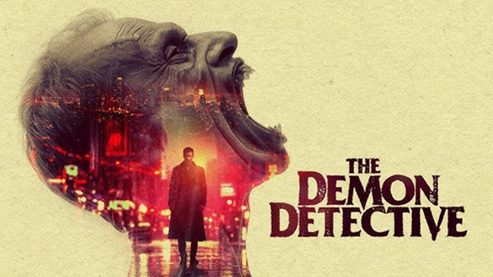
Recently he turned his ear toward the supernatural with The Demon Detective (streaming now!), directed by T.C. De Witt and starring Doug Jones, Adrienne Barbeau, Eugene Young, Joy Regullano, Dani J. Scott, and Vivica A. Fox. The story follows Miles Mako (Dustyn Gulledge), a professional exorcist drawn into a case that forces him to confront a demon — and his own past. I spoke with Neely about how he shaped the film’s eerie soundscape, the instruments he bent to his will, and the challenges of scoring a tale where horror collides with noir.
💀💀
PopHorror: What was your first instinct musically when you read the script for The Demon Detective — did you hear a melody, a rhythm, or just a mood?
Barry J. Neely: This rising/stuttering synth with a harsh tremolo cello kept on playing over and over in my head. I’m not sure why I heard that, nor did I know where it was going. But those two sounds were lying on top of each other in conjunction, even though in the final soundtrack, I had them call-and-answering.
As far as learning about the movie and story, I actually had the opportunity to see the whole first 10 minutes early on, before I read the script, because they had shot it as both a short film and proof of concept. So, maybe that’s where that initial music idea was inspired by. You start with a big idea — like that sound — and then you extract from there, and branch off from there. And that synth sound as well as the hard tremolo cello
definitely plays a lot in various ways throughout the score.
PopHorror: Your past work often twists conventional instrumentation — are there any unusual
sound sources or techniques you used to bring out the film’s supernatural edge?
Barry J. Neely: I probably went more “traditional” by using a string trio. Smaller ensembles have such
awesomely gritty feel to them, and I wanted a strong, up-front sound. But another whole layer to this score was the voices I used. I asked my friend Morla Gorrondona (X-Men 87, Destiny 2, Red One) to record some scratchy, screeching vocals. She sent me some awesome, experimental sounds she recorded in her iPhone,
then later she was going to send me “better” recordings. But I sampled those iPhone recordings immediately and played around with them a ton, quickly formulating ideas with those less-than-quality recordings.
And I found that the mid-range sound was better at cutting through the mix, so I didn’t even bother with the better-quality recordings! Throughout, you’ll hear almost 3 distinct categories of voices: the scratchy/monstrous
iPhone vocals of Morla, and a sweeter, clean voice, voiced by Zehra Fazal (Borderlands 3, Wonder Woman in Suicide Squad Kill The Justice League), and a trio of voices by Morla, Zehra, and Victoria Fox, who all play the role of “the chorus.” These sounds are all layered throughout, invoking what I felt were the demons that haunted the main character, Miles Mako.
PopHorror: How do you balance the horror elements with the detective/noir side of the story? Did
you lean into one genre musically more than the other?
Barry J. Neely: I definitely went more horror with this one. I asked the director T.C. at the beginning “how ‘cool’ is Miles?” But T.C. didn’t really seem too strong about this being an aspect of his character. So right away, I focused on Miles’s trauma instead of his “detective-ness”, which lent itself more to horror, but also to sadness and an all-around, personal struggle. Now, if there’s a sequel, I’ve already touched on his inner demons, next time I could focus on the more noir aspects.
PopHorror: Miles Mako has a dark past tied to the demon. How did you reflect that history in his
musical theme without giving too much away too soon?
Barry J. Neely: Instead of tying Miles to the final demon, Uzgarath — played by the iconic Doug Jones — I
tied Miles more to the sister he lost TO Uzgarath. I always felt like Miles was more of a traumatic character. So one of the screams that Morla recorded for me — she recorded about 3 distinct sounds — were sprinkled throughout the entire score. Will anyone realize that this one piano melody and how that and that scream-like sound is tied to Mya, and thus Uzgarath — maybe!
PopHorror: You’ve worked with quirky textures before, like soda cans and altered instruments. Did The Demon Detective push you toward more experimental or more traditional scoring choices?
Barry J. Neely: Percussion lends itself to some really fun experimentation in terms of “found objects”
and I didn’t feel that had a place in this score, nor did rhythms in general. I used low-toned taiko drums, but nothing in the upper registers. And I probably went more traditional route with the sound of the string trio. But I guess you could say I used those strings very percussively and harshly. They certainly stand out a lot in this score.
PopHorror: The film stars Doug Jones, Adrienne Barbeau, and Vivica A. Fox — each with strong
screen presence. Did their performances inspire or change your approach to certain cues?
Barry J. Neely: Let’s just say that all three of their careers have impacted me in so many ways since
they’re all absolute legends. So, their performances are hugely appreciated, but it was the characters of Miles and Clara that drove the music.
I had a theme for Adrienne’s character, because there’s this vast, unspoken backstory with her. In the final film, we didn’t end up using that theme to the extent I originally scored it, but maybe there’ll be an opportunity to bring her back into the fold, and that original theme, in a sequel.
PopHorror: Director T.C. De Witt has a unique voice. How did your collaboration with him shape
the score’s direction?
Barry J. Neely: I really listened to how T.C. talked about the demons, because he was just so passionate
about it. He did a ton of research for this movie and clearly knows true demonology and I wanted to honor that with the music. A lot of film scoring goes on “feel.” And so a lot of my writing has more to do with HOW the director talks about a certain scene, not necessarily what they would do music-wise.
PopHorror: In horror scoring, silence can be just as important as sound. Did you intentionally
carve out moments where music steps back to heighten the tension?
Barry J. Neely: In my talks with the director, we talked about using a sound out of the range of human
hearing. So I created a really super high-pitched sound from a thrift store violin. I didn’t even have a violin bow for it, so I used an old cello bow that I had, which made it difficult to produce any pure tones, which I guess helped! I know that doesn’t seem particularly innovative, but trust me, it’s much larger and harder to use on a much-smaller violin.
To get specific, using this tone as more of a sound design element helped shape the scenes where we didn’t think music was necessary. I’m a big fan of silence in movies, and I think we held back from having this wall-to-wall music, but this tone gave us a third option.
PopHorror: Was there a particular scene or sequence that proved the most challenging to score,
and how did you solve it musically?
Barry J. Neely: The gym scene with the demon, Illizod (Phil Tyler), was the hardest by far. It’s longer, for one, so
how do you keep the music in the horror genre and still keep it interesting? Well, on my first attempt, I don’t think I hit the mark. We finished the movie as a whole, but thankfully, the producer let me go back and revise that cue.
As with a lot of revisions, the “guts” of the music is there, so it’s more about bringing out the more important elements. And sometimes, only time allows you to realize which parts are truly important. I sat down with one of the producers, and we softened some of the drums, making it less “adventure”-sounding, and brought the scarier vocal layers out, and distorted the choir vocals a bit. Those revisions made the whole thing work
better.
PopHorror: Looking at your body of work—quirky comedies, raw dramas, chilling horror — where
does The Demon Detective sit in your musical journey? Did it reveal something new
about your voice as a composer?
Barry J. Neely: Wow, great question. I pride myself on being very consistent in my musical themes, and
bringing them in and out in so many various ways. I’m pretty staunch with that, so in that
sense I kept that workflow in this film.
But this was honestly my first score I’ve actually been able to go into the studio and record live musicians in an ensemble. A lot of the things I work on are low budget, which lends itself to creative ways of doing things, but…also me doing mostly everything. I guess in a way this score showed me that I can keep that “scrappy” way of doing things, but also when I have more tools and resources at my disposal, I might be able to create
something really fu and INTENSE. And I feel like — and what I’ve heard from many people — is that this score “goes hard,” and honestly that’s what I love about it.
Barry’s The Demon Detective score is available now.
14 minutes ago
5 hours ago
10 hours ago
Jem Garrard’s Takeout is a new Tubi original movie that you won’t want to sleep …
You must be logged in to post a comment.
This site uses Akismet to reduce spam. Learn how your comment data is processed.
Interview: Barry J. Neely on Crafting Music for ‘THE DEMON DETECTIVE’ (2025) – PopHorror