
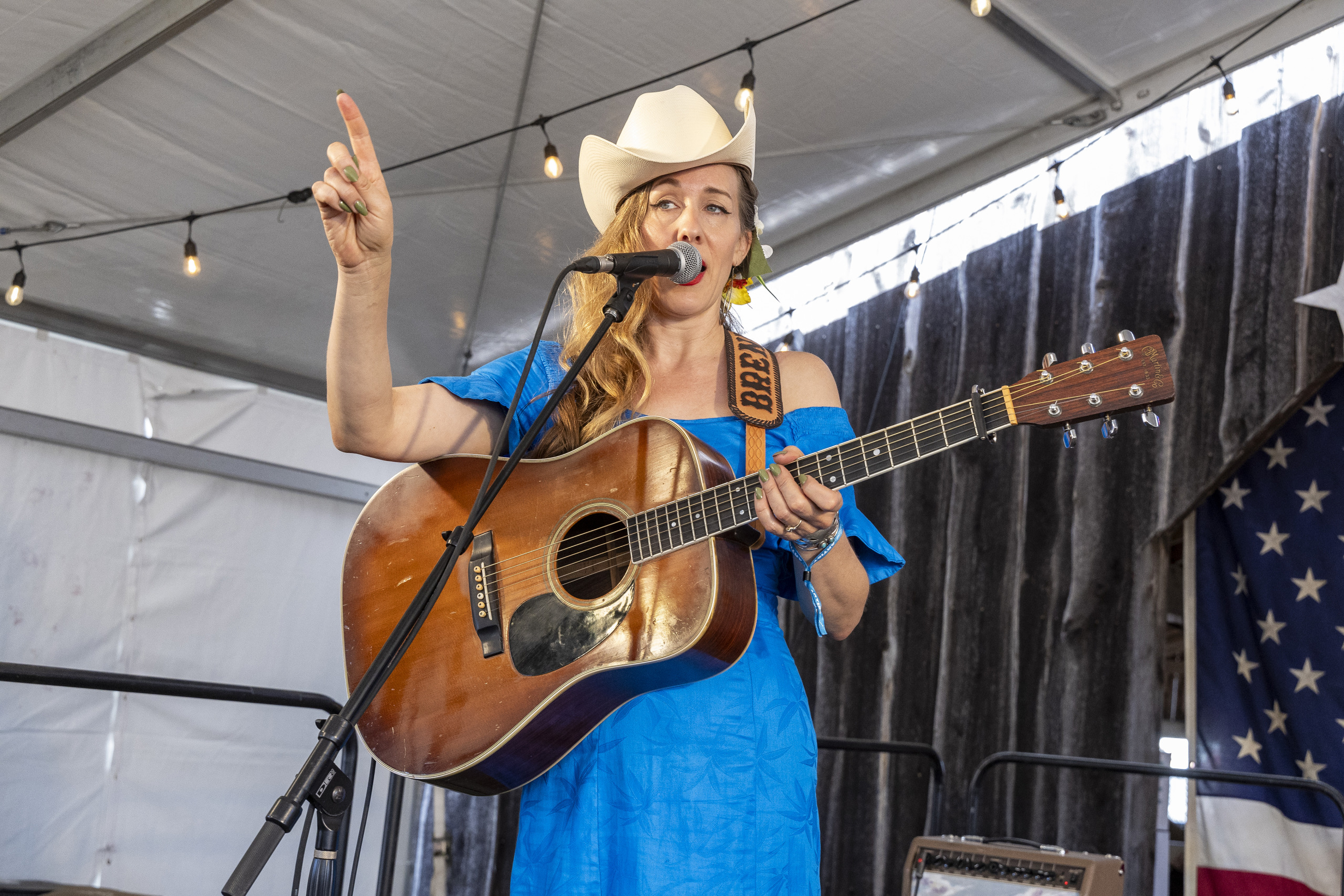
With her latest album, the country music star pursues a timeless tradition.
Brennen Leigh has an affinity for authenticity. That’s been clear throughout her career, and it’s been proven once again in her exceptional new album, the tellingly-titled Don’t You Ever Give Up On Love. It’s classic country from start to finish, courtesy of songs that share both hope and heartbreak as told from the perspective of one who knows those feelings firsthand and is unafraid to allow her feelings to flow with torrents of melody and meaning. It combines desire and desperation in equal measure, with songs such as “Alone in the Lone Star,” “I’m Easy To Love After All,” “Nothin’ You Can’t Fix,” “Thank God You’re Gone,” A Reason To Drink,” “You’re Finally Hurtin’.” How’s The Gettin’ Over Me Going,” and the title track each offering a no-holds barred expression of emotion and ingenuity within a pure classic country template.
It’s not the first time Leigh has reclaimed that timeless legacy. Obsessed With The West found her teaming up with Asleep at the Wheel for a set of western swing. Likewise, Ain’t Through Honky Tonkin’ Yet made no secret of her desire to return to an era when those rural roots reigned and all it took was a two-step to reel in feelings and finesse.
Goldmine recently had the opportunity to speak with Miss Leigh, who was all too pleased to speak about the love she has for that legacy.
Goldmine: It’s been evident throughout your career that you as an artist have taken your cue from classic country music. Yet the new album almost seems like a concept album when it comes to dealing with disappointment and despair. Was that your intent?
Brennen Leigh: Well, maybe the only thing that would have intentionally or unintentionally put it in that category was the time period in which I wrote the songs. I didn’t write them for the album per se, like some people who sit down and write an album purposely. I wrote them between 2023 and 2024, but I have to actually look at the track listing to even tell you that, because I know some of them are older. It does have those themes, and that’s what drew me to country music in the first place, specifically, the stories and real life, the very human emotions that we all feel. And if you take that out of it, you end up with something that doesn’t resemble the original idea anymore. For me, it is my soul music. It’s my vernacular and my culture, and always has been.
GM: So can you give us some idea about how these songs came together?
BL: Some of them are stories that happened to me directly, and some of them are stories that happened to people I know directly. Some of them are ideas that I wrote a song around. It’s funny how some people tend to assume that what you sing about is autobiographical, but that’s not always the case. Sometimes I’m singing in the first person, but it’s about a friend of mine. However, I’m making it sound like it’s about me. In some of these, like the song “You’re Finally Hurtin’,” that was just about someone that my friend Rachel and I knew, and a guy that just continued to make a fool of himself over this woman who was clearly sort of toying with him. So then he found out the consequence based on denial will come and get you sooner or later. I just think that’s universal. Consequences are universal, and it’s one of my favorite topics in country music, that sort of gloating a little bit at someone else’s misfortune after they hurt you. These are things that these days are largely extinct in modern country music. People like Porter Wagoner and Faron Young and people like that, served up shame and regret as one of their main courses, and it was all the result of consequence.
GM: These songs build on a similar analogy. There’s a vulnerability that’s present but there’s also humor and irony as well. And it comes from the powers of observation. It’s an interesting concept.
BL: Thank you. Yeah, some of these songs really are borne out of some of the worst experiences that I personally ever had, but in those instances, humor was the thing that got me through it. To me, the best songs, even the saddest songs, have a little bit of humor. A song like “He Stopped Loving Her Today” has a punch line. ”She Thinks I Still Care” is tongue-in-cheek, and I think that humor is what brings things up a little bit for the listener, and for the singer [George Jones].
GM: Agreed. There’s more than a hint of irony there, and the play on words is so inherent in country music as a whole. It’s that ability to turn a phrase and have it mean one thing, but at the same time, you know, make it an analogy. That’s a hook in itself, you know. And that’s what we have here with this album. It’s found in these titles — “I’m Easy To Love After All” or “Nothin’ You Can’t Fix” or “A Reason To Drink” or “Thank God You’re Gone.” They state the obvious but it becomes a sort of play on words in, in a sense. So too, that song called “How’s the Getting Over Me Going” certainly boasts a clever title.
BL: One thing I really love about country music is that there are so many different kinds. When I first came into it, when I was just a kid, my mom and dad were big country fans. And they liked to play it for fun, just in the living room. And they also listened to a lot of old country music, people like Emmylou Harris and Willie Nelson and Asleep at the Wheel. I discovered all that music through my parents, and then, when I was a young teenager, I went full on with my special interest in it, and just it. I became obsessed with it, like it was my whole entire life. And I never stopped. I’m still digging through it because there’s so much of it. My favorite era is probably the ’40s and maybe through the ’60s. But like a lot of people that do classic country — and that’s such a broad term— they focus on the ’60s and ’70s. I tend to be a little earlier than that. I started Jimmie Rodgers and go forward.
GM: Sadly, much of what passes for country music is so commercial and homogenized these days. It seems to have lost its purity.
BL: I don’t know if I could say it ever had any purity, so to speak, but I know what you mean. It had an authenticity that was less commercial. I kind of think some people would laugh at me for saying this, but I think when you take the intelligence out of something, it makes it less fun. And my favorite country music is smart. Even some of the more — I don’t want to use the word hokey — but kind of like a little bit hokey. Or songs by Little Jimmy Dickens or Roy Acuff, that stuff had smarts to it. You had to think a little bit more with those songs. If you listen to some of Dolly Parton’s songs, they’re really thinking person songs. They’re literary. I like the stories. You can dwindle it down to just a drum beat or a stupid phrase that everyone can repeat. It kind of takes away the story. It puts that front and center and takes the story away. I miss the stories. That’ll always be the important thing to me — the stories.
GM: There are certainly some stories on this album. It’s almost as if you’re painting all this aural imagery. The stories really are front and center, allowing the listener to follow a narrative and anticipate how the plot is going to develop from there. So how did you develop that talent? You really are proficient at it, and that’s no small skill to be able to do what you do.
BL: Thank you. I just liked writing, and I liked reading from the time I was young. I learned a lot from reading and a lot about clarity and telling the truth. Sharing lucidity in a story matters more than me getting my feelings out there. You can tell a story by showing people what’s going on. You don’t have to beat people over the head. You can show them the things that give them clues, and that way it feels more like watching a movie than reading an essay. Just speak to them like you’re telling a story.
GM: The song “Tell Me” seems to be a good example of that.
BL: I just imagined it as a phone call. I’m calling this person. I already know what’s up, but I want them to say it. That’s a common situation that people find themselves in, that sort of heartbreak. You already know the unfortunate development there.
GM: Many people will be able to relate to these story songs that you share here in a very specific way. There’s a real connection with these songs, and yet it is kind of like a movie or where you’re looking forward to the next scene and you’re kind of in suspense. You can connect with the character in the song. That’s what makes a good story. It’s a wonderful talent to be able to convey that, and it allows the listener to dig deeper, so to speak. So was there a special moment, sort of an “aha” moment, where you told yourself, “I can do this, I can make a career out of this?”
BL: I couldn’t even drive yet. I was like 14, and that’s when I started playing out. My brother and I played a lot of gigs. We grew up in the Midwest, close to Fargo, North Dakota. And we were just crazy about country music. So before I even had a driver’s license, we were playing all kinds of different venues, and I was already, and I use this term loosely, making money at it. So by the time it would have been going to college, it was like I could go learn to do something else, or I could continue to do this. And it just kind of seemed like a no-brainer to continue. I already had a job, so why not continue to do it? I never had a chance to quit my job, because it had been my job ever since I was a teen.
GM: It seems like you were some sort of child prodigy.
BL: I definitely was not. I definitely got better with age. I hadn’t found my voice yet, and I wasn’t a good guitar player yet. Actually, I just played mandolin in those days, but I wasn’t any good. But my brain was good, and so that was the thing I sort of ended up doing, cultivating the songwriting, and that was what ended up clicking as a more sustainable lifelong thing for me to do.
GM: So, when did you record your first album?
BL: I was 18. Really more like 17, but I was 18 when it came out. It was released on a small record label out of Fargo, North Dakota, and that label and the album are no more. It’s out of print. But it actually did help me, because I moved to Texas shortly after that, and it helped me get shows. And in those days, it wasn’t that everybody who was making an album was getting there, but it helped me. I had a professionally made, cool record right out of the gate.
GM: So what was the name of that album?
BL: It was called Lonesome, Wild and Blue. You can find it on eBay sometimes, but they are rare.
GM: Hopefully, you kept a few copies for yourself.
BL: My parents had a couple. I won’t listen to it, but maybe when I’m old, I will.
GM: So how would you describe your trajectory from those early beginnings, that initial album, to where you are now? How do you think you developed your efforts overall?
BL: I played live a lot. I toured a lot. I went to Europe. I toured the U.S. a lot. And I moved to Austin, and I spent quite a bit of time there, playing around Texas and touring outside of Texas, and that’s sort of where I learned to play. And then in 2017, I moved to Nashville. I got a publishing deal, and that was like a whole different era. The caliber of musicians there is really high, and I got to play with incredible people, and I personally got to be a much better player. I also learned a lot about marketing and I learned a little more about how to present myself and how to put music out, and throughout that whole time, I collaborated with a lot of cool and different people, and so I would credit that with kind of being the thing that’s kept me feeling relevant — all the collaborations I’ve gotten to do. I’m proud of all of those things.
GM: Notably, you put out an album with Noel McKay.
BL: Noel taught me more about songwriting than probably anybody.
GM: So where do you call home now?
BL: I moved back to Texas about eight months ago, but I moved to East Texas, not Austin. I lived in Nashville for seven years. Everybody thinks that I moved back to Austin. Kevin [Skrla], my producer, grew up here, and that’s where we made this record. I like both places. They both have their things, and people are mostly the same everywhere you go,
GM: Are you planning on touring behind the new record?
BL: We’re already picking out our outfits!
GM: That’s part of carrying on the tradition. You’ve got to dress the part, right?
BL: It’s one of the most fun things about playing country music. You get to dress up like you’re going to the circus or something,
GM: So you still enjoy touring and performing live?
BL: I really do. I’ve always been somebody who likes to travel. I like going to new places. It never gets old. It has gotten a bit tougher in recent years. The overhead is higher. The ticket situation is changed. The way people promote shows, the rates. But I just love meeting people. That’s the best part, getting to play for folks who are fans.
Get the latest issue of Goldmine magazine by clicking below