
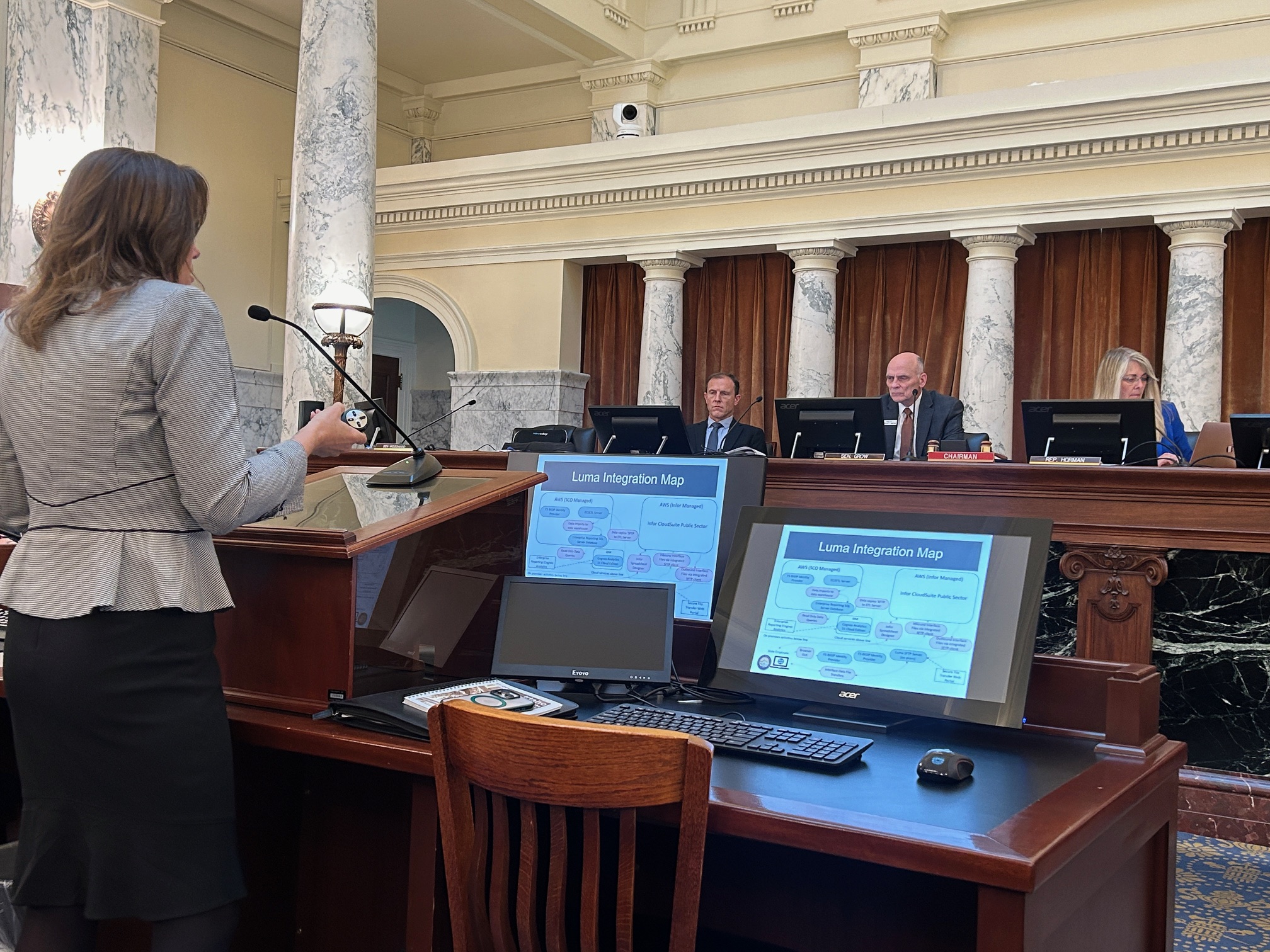
Legislative Services Office Audit Division Manager April Renfro gives an update on an annual statewide budget audit to members of the Joint Finance-Appropriations Committee on Nov. 5, 2025, at the Capitol in Boise. (Photo by Laura Guido/Idaho Capital Sun)
Delays and errors in Idaho’s annual statewide budget audit will likely lead to further delays and errors going uncorrected in next year’s audit. Those delays caused a delay in submission of a separate required audit of federal money, which is leading to questions from federal grantors.
Idaho statewide audit finds significant errors in financial reporting driven by Luma system
Legislative Services Office Audit Division Manager April Renfro outlined issues in the state’s fiscal year 2024 state budget audit caused by the major transition to a new accounting and business system at a Joint Finance-Appropriations Committee meeting Wednesday at the Capitol in Boise.
JFAC co-chair Sen. Scott Grow, R-Eagle, said the delays and errors on the audit report prompted some “significant financial concerns,” related to the state’s bond rating and rates. Co-chair Rep. Wendy Horman, R-Idaho Falls, noted that Idaho’s AAA bond rating last month was affirmed by Moody’s Rating.
Another audit that is required for entities that spend large amounts of federal money and grants is already delayed because of the work and issues on the Annual Comprehensive Budget Report, Renfro said.
Many of the errors found in this year’s audit won’t have time to be corrected by the time the state has to submit another one in December, Renfro said.
“They will not have time, if we identify the error, to make corrections for fiscal year ‘25,” Renfro said.
Delays and significant errors could lead to future federal grants being under threat
The report’s findings included financial misstatements of hundreds of millions of dollars for some agencies, duplicated payments, and a lack of processes to verify accuracy of statements between the State Controller’s Office, Idaho State Treasure’s Office, and the bank, the Idaho Capital Sun reported.
The state is required to submit the report each year, but delays caused by the transition to the state’s new business and accounting management system, called Luma, meant it wasn’t complete until September, nine months after it was due.
The state is also required to submit the Single Audit to ensure compliance with the law in expenditures of federal grants. The report was due in March, Renfro told lawmakers, but isn’t likely to be submitted until the end of this month.
“We’ve had feedback from a couple of different agencies that grantors are threatening funding related to not having the Single Audit out,” Renfro said. “We’re doing the best that we can to get it out in time, but we also know we need responses from the agencies, so that’s why we’re pushing really hard to begin by the end of November.”
Issues in the annual state budget report stemmed from Luma transition
The report looked at the state’s financial statements for fiscal year 2024, which ran July 1, 2023, to June 30, 2024, which coincided with the state’s bumpy overhaul of its accounting and business systems as it switched to Luma.
This year’s audit included eight “qualified opinions,” meaning the finding was significant enough that there could be a material error in reporting, largely because the documentation wasn’t adequate for auditors to verify accuracy.
Auditors found in one case that the Department of Health and Welfare’s account overstated the cash on hand by $433.6 million, or the State Controller’s Office had overstated revenue by $102.3 million and expenditures by $178.3 million, among other errors in financial statements.
Renfro told lawmakers Wednesday that in the more than 26 years she’s been with the legislative auditor’s office, she’s never seen the state get a qualified opinion before.
Many of the issues were driven by a lack of process for reconciliation to verify numbers and statements between the agencies, the Idaho Treasurer’s Office, and the bank. There had been a process in place to do this prior to the switch to Luma. Auditors also found interface issues with Luma, a lack of appropriate reports being generated, and insufficient training on the new system.
“Why is it important that you hear this?” Horman said to the committee members. “Because if you saw an agency in there that had a problem, a material misstatement and deficiency, sometimes you need to go in and add appropriation language to get them to comply.”
YOU MAKE OUR WORK POSSIBLE.
by Laura Guido, Idaho Capital Sun
November 5, 2025
by Laura Guido, Idaho Capital Sun
November 5, 2025
Delays and errors in Idaho’s annual statewide budget audit will likely lead to further delays and errors going uncorrected in next year’s audit. Those delays caused a delay in submission of a separate required audit of federal money, which is leading to questions from federal grantors.
Idaho statewide audit finds significant errors in financial reporting driven by Luma system
Legislative Services Office Audit Division Manager April Renfro outlined issues in the state’s fiscal year 2024 state budget audit caused by the major transition to a new accounting and business system at a Joint Finance-Appropriations Committee meeting Wednesday at the Capitol in Boise.
JFAC co-chair Sen. Scott Grow, R-Eagle, said the delays and errors on the audit report prompted some “significant financial concerns,” related to the state’s bond rating and rates. Co-chair Rep. Wendy Horman, R-Idaho Falls, noted that Idaho’s AAA bond rating last month was affirmed by Moody’s Rating.
Another audit that is required for entities that spend large amounts of federal money and grants is already delayed because of the work and issues on the Annual Comprehensive Budget Report, Renfro said.
Many of the errors found in this year’s audit won’t have time to be corrected by the time the state has to submit another one in December, Renfro said.
“They will not have time, if we identify the error, to make corrections for fiscal year ‘25,” Renfro said.
Delays and significant errors could lead to future federal grants being under threat
The report’s findings included financial misstatements of hundreds of millions of dollars for some agencies, duplicated payments, and a lack of processes to verify accuracy of statements between the State Controller’s Office, Idaho State Treasure’s Office, and the bank, the Idaho Capital Sun reported.
The state is required to submit the report each year, but delays caused by the transition to the state’s new business and accounting management system, called Luma, meant it wasn’t complete until September, nine months after it was due.
The state is also required to submit the Single Audit to ensure compliance with the law in expenditures of federal grants. The report was due in March, Renfro told lawmakers, but isn’t likely to be submitted until the end of this month.
“We’ve had feedback from a couple of different agencies that grantors are threatening funding related to not having the Single Audit out,” Renfro said. “We’re doing the best that we can to get it out in time, but we also know we need responses from the agencies, so that’s why we’re pushing really hard to begin by the end of November.”
Issues in the annual state budget report stemmed from Luma transition
The report looked at the state’s financial statements for fiscal year 2024, which ran July 1, 2023, to June 30, 2024, which coincided with the state’s bumpy overhaul of its accounting and business systems as it switched to Luma.
This year’s audit included eight “qualified opinions,” meaning the finding was significant enough that there could be a material error in reporting, largely because the documentation wasn’t adequate for auditors to verify accuracy.
Auditors found in one case that the Department of Health and Welfare’s account overstated the cash on hand by $433.6 million, or the State Controller’s Office had overstated revenue by $102.3 million and expenditures by $178.3 million, among other errors in financial statements.
Renfro told lawmakers Wednesday that in the more than 26 years she’s been with the legislative auditor’s office, she’s never seen the state get a qualified opinion before.
Many of the issues were driven by a lack of process for reconciliation to verify numbers and statements between the agencies, the Idaho Treasurer’s Office, and the bank. There had been a process in place to do this prior to the switch to Luma. Auditors also found interface issues with Luma, a lack of appropriate reports being generated, and insufficient training on the new system.
“Why is it important that you hear this?” Horman said to the committee members. “Because if you saw an agency in there that had a problem, a material misstatement and deficiency, sometimes you need to go in and add appropriation language to get them to comply.”
YOU MAKE OUR WORK POSSIBLE.
Idaho Capital Sun is part of States Newsroom, a nonprofit news network supported by grants and a coalition of donors as a 501c(3) public charity. Idaho Capital Sun maintains editorial independence. Contact Editor Christina Lords for questions: info@idahocapitalsun.com.
Our stories may be republished online or in print under Creative Commons license CC BY-NC-ND 4.0. We ask that you edit only for style or to shorten, provide proper attribution and link to our website. AP and Getty images may not be republished. Please see our republishing guidelines for use of any other photos and graphics.
Laura Guido covers state politics for the Idaho Capital Sun. She previously covered the Legislature and state government for the Idaho Press and several other papers from around the state. Before coming to Boise, Laura was managing editor of the Woodinville Weekly and a reporter at the Whidbey News-Times. She grew up in Pullman and got a multimedia journalism degree from Washington State University.
Idaho Capital Sun is part of States Newsroom, the nation’s largest state-focused nonprofit news organization.
DEMOCRACY TOOLKIT
© Idaho Capital Sun, 2025
v1.96.6
The Idaho Capital Sun is the Gem State’s newest nonprofit news organization delivering accountability journalism on state politics, health care, tax policy, the environment and more.
We’re part of States Newsroom, the nation’s largest state-focused nonprofit news organization.
Our stories may be republished online or in print under Creative Commons license CC BY-NC-ND 4.0. We ask that you edit only for style or to shorten, provide proper attribution and link to our website. (See full republishing guidelines.)
© Idaho Capital Sun, 2025