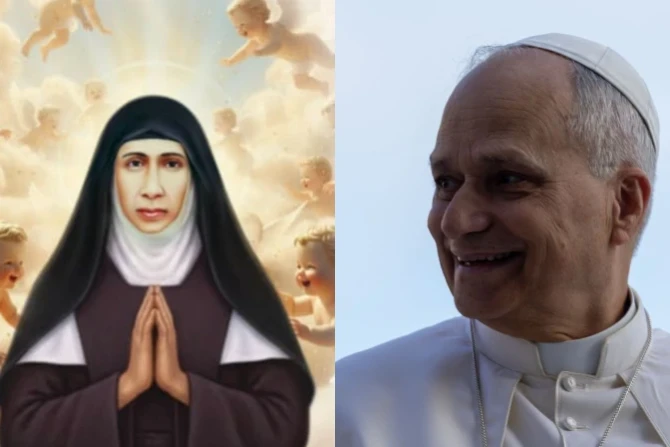
 By Victoria Cardiel for CNA
Vatican City, Nov 12, 2025 / 16:24 pm
Pope Leo XIV spoke of the beatification this week of Mother Elisva Vakha’i, a 19th-century Indian religious and founder of the Third Order of the Teresian Discalced Carmelites, highlighting her “courageous commitment to the emancipation of the poorest girls.”
“The witness of Mother Elisva Vakha’i,” the pope affirmed during his greetings in Italian at the end of his general audience on Nov. 12, “is a source of inspiration for all who work in the Church and in society for the dignity of women.”
The beatification ceremony on Nov. 8 was held in the square in front of the Basilica-Shrine of Our Lady of Ransom in Vallarpadam, Kochi, in the Indian state of Kerala, and was presided over by Cardinal Sebastian Francis, bishop of Penang, Malaysia.
Before thousands of faithful and men and women religious from across the country, the cardinal emphasized that the new blessed represents “a beacon of hope” for all “consecrated women, for all mothers, and for all those who suffer in silence and yet choose to love,” according to Vatican News.
Before embracing religious life, Vakha’i was married and had a daughter. She decided to take religious vows after becoming a widow, an experience that profoundly shaped her vocation and endowed her with a special sensitivity to the needs of women in her time. In a society marked by rigid cultural and religious divisions, she recognized the dignity of every person and offered concrete opportunities for education and support.
In the mid-19th century, she founded an orphanage and a primary school for the poorest and most marginalized young women. Her work was not limited to mere assistance: It was a genuine commitment to the integral formation of women; she was convinced that education was the key to the social recognition of their dignity and active participation in social and ecclesial life.
Vakha’i opened a new path for the women of Kerala, allowing them enter religious life in both the Latin and Syro-Malabar rites. Her project, deeply rooted in Carmelite and Teresian spirituality, united contemplation, service, prayer, and education.
Her example inspired her own sister, Thresia, and her daughter, Anna, who joined her in founding the first Discalced Carmelite convent in Kerala in 1866, under the spiritual guidance of Italian Carmelite missionaries. Together, they fostered a community experience that, as Cardinal Francis emphasized in his homily during her beatification, anticipated ecclesial insights now associated with the synodal journey of the Church.
During the homily at the beatification, the cardinal emphasized the “inclusive vision” of Vakha’i, with which she “was ahead of her time and is a true expression of synodality in action: walking together in communion.”
The new blessed, he added, “shows the way” to the Church on its synodal journey “listening, discerning, and walking together.”
The foundation of her “unwavering faith,” he affirmed, “lies in her spirituality, vision, and mission, all rooted in her identity as a faithful disciple of Jesus Christ through baptism, the very heart of synodality.”
With the official recognition of her holiness, the Church proposes Vakha’i as a model of evangelical life embodied in service to the poor, in the promotion of women, and in the building of fraternal communities.
This story was first published by ACI Prensa, CNA’s Spanish-language news partner. It has been translated and adapted by CNA.
If you value the news and views Catholic World Report provides, please consider donating to support our efforts. Your contribution will help us continue to make CWR available to all readers worldwide for free, without a subscription. Thank you for your generosity!
Click here for more information on donating to CWR. Click here to sign up for our newsletter.
Sister Mary Michael, last of Mother Angelica’s founding nuns, dies at 94
Your email address will not be published.
All comments posted at Catholic World Report are moderated. While vigorous debate is welcome and encouraged, please note that in the interest of maintaining a civilized and helpful level of discussion, comments containing obscene language or personal attacks—or those that are deemed by the editors to be needlessly combative or inflammatory—will not be published. Thank you.
*
*
Sportsmanship and the season of our discontents
Extra, extra! News and views for Wednesday, November 12, 2025
U.S. bishops elect Archbishop Paul S. Coakley as USCCB president
Opinion: Don’t blame Descartes—the dualism runs deep
Vatican City, Jan 1, 2022 / 09:35 am (CNA).
On New Year’s Day, Pope Francis encouraged people to place their lives under the protection of Mary, the Mother of God.
“The new year begins under the sign of the Holy Mother of God, under the sign of the Mother. A mother’s gaze is the path to rebirth and growth. We need mothers, women who look at the world not to exploit it, but so that it can have life,” Pope Francis said in St. Peter’s Basilica on January 1.
“At the beginning of the New Year, then, let us place ourselves under the protection of this woman, the Mother of God, who is also our mother. May she help us to keep and ponder all things, unafraid of trials and with the joyful certainty that the Lord is faithful and can transform every cross into a resurrection,” the pope said.
Pope Francis’ first public act of 2022 was to offer Mass for the Solemnity of Mary, Holy Mother of God.
In his homily, the pope said that the Virgin Mary teaches us how to “keep and to ponder,” to reflect upon and accept life as it comes, in times of both joy and suffering.
“Mary’s pensiveness … is the expression of a mature, adult faith, not a faith of beginners. Not a newborn faith, it is rather a faith that now gives birth,” he said.
“For spiritual fruitfulness is born of trials and testing. From the quiet of Nazareth and from the triumphant promises received by the Angel – the beginnings – Mary now finds herself in the dark stable of Bethlehem. Yet that is where she gives God to the world.”
The pope asked people to reflect on how Mary had to endure “the scandal of the manger.”
“How can she hold together the throne of a king and the lowly manger? How can she reconcile the glory of the Most High and the bitter poverty of a stable? Let us think of the distress of the Mother of God. What can be more painful for a mother than to see her child suffering poverty? It is troubling indeed,” he said.
“We would not blame Mary, were she to complain of those unexpected troubles. Yet she does not lose heart. She does not complain, but keeps silent. Rather than complain, she chooses a different part: For her part, the Gospel tells us, Mary ‘kept all these things, pondering them in her heart.’”
Pope Francis encouraged people to have the same attitude of Mary when faced with unexpected problems or troubling situations.
“She shows us that it is necessary: it is the narrow path to achieve the goal, the cross, without which there can be no resurrection. Like the pangs of childbirth, it begets a more mature faith,” he said.
After offering Mass, Pope Francis prayed the Angelus at noon from the window of the Apostolic Palace with a crowd gathered below in St. Peter’s Square.
“Happy New Year! Let us begin the new year by entrusting it to Mary, the Mother of God,” he said.
“The new year begins with God who, in the arms of his mother and lying in a manger, gives us courage with tenderness. We need this encouragement. We are still living in uncertain and difficult times due to the pandemic,” the pope said.
“Many are frightened about the future and burdened by social problems, personal problems, dangers stemming from the ecological crisis, injustices and by global economic imbalances. Looking at Mary with her Son in her arms, I think of young mothers and their children fleeing wars and famine, or waiting in refugee camps. There are so many of them.”
Pope Francis said that the thought of Mary holding Jesus in the stable is a reminder that “the world can change and everyone’s life can improve only if we make ourselves available to others.”
He recalled that January 1 marks the World Day of Peace, instituted by St. Paul VI in 1968.
“We can truly build peace only if we have peace in our hearts, only if we receive it from the Prince of peace. But peace is also our commitment: it asks us to take the first step, it demands concrete actions. It is built by being attentive to the least, by promoting justice, with the courage to forgive thus extinguishing the fire of hatred,” he said.
“At the beginning of this year, may the Mother of God, the Queen of Peace, obtain harmony in our hearts and in the entire world,” Pope Francis said.
[…]
© Catholic World Report
You can see how this popup was set up in our step-by-step guide: https://wppopupmaker.com/guides/auto-opening-announcement-popups/
Sign up to receive a weekly email with news, analysis, and commentary from a voice you can trust!
Pope Leo XIV proposes 19th-century Indian religious as a model of women’s emancipation – Catholic World Report