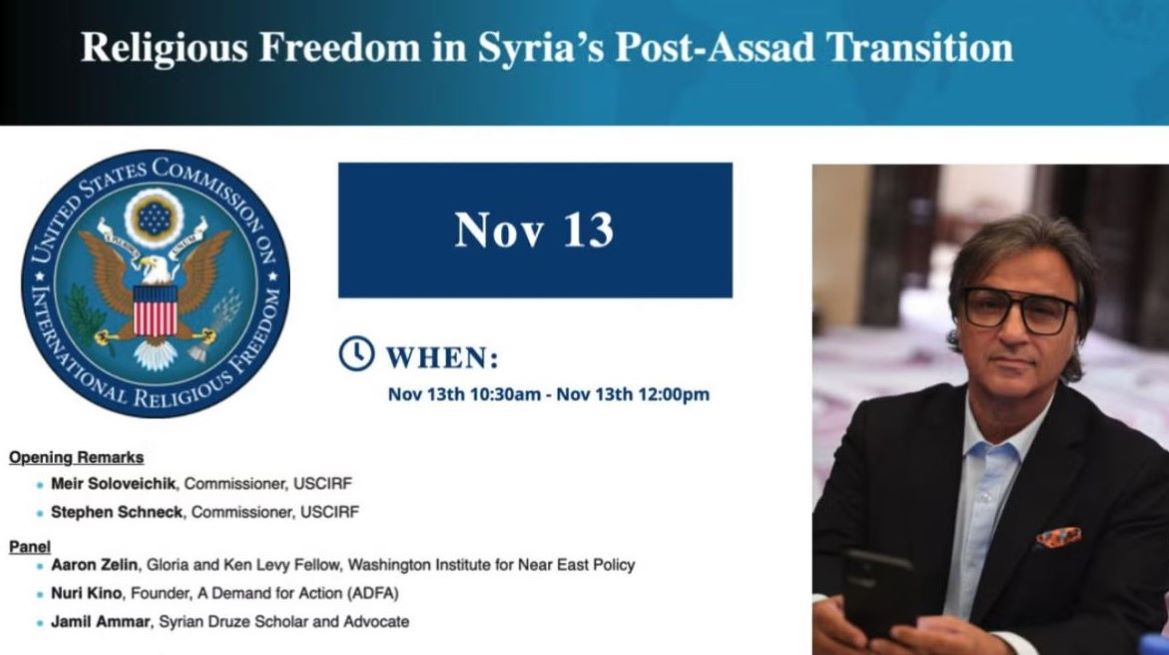
WASHINGTON D.C. — Nuri Kino, founder of the international advocacy organization A Demand for Action (ADFA), delivered a warning during a virtual hearing of the U.S. Commission on International Religious Freedom (USCIRF). The session, held on 13 November and titled “Religious Freedom in Syria’s Post-Assad Transition,” examined the state of minority rights since the overthrow of President Bashar al-Assad last December and the rise of a new government led by President Ahmed al-Sharaa.
Kino began by recounting the burial of Maryana, a teenager who was martyred when an armed man stormed the Greek (Rûm) Orthodox Mar Elias Church on June 22, opening fire on worshippers before detonating an explosive vest. Dozens of worshippers present lost their lives or were injured, in what rights groups describe as the deadliest assault on Syria’s Christians since the 1860 Daramsuq (Damascus) Massacre.
“At her funeral, her mother held her hand through the coffin window as church bells tolled,” Kino told commissioners. “Friends and family threw sweets over her coffin — a wedding tradition for the bride she would never become.”
He said the funeral ceremony had come to symbolize “the ethno-religious cleansing of Syria’s ancient minorities, of its Christian indigenous people.” Christians once accounted for roughly 10 percent of Syria’s pre-war population. Years of fighting, persecution, and mass displacement have reduced that number dramatically.
Nuri Kino said attacks on the Christian community did not cease with Assad’s fall. The former Al-Qaeda affiliate militia Hayat Tahrir al-Sham (HTS), now dissolved, in charge of Daramsuq and delisted as a terrorist organization by the US, has not demonstrated a clear policy framework for protecting minorities, he argued. “The destruction of churches, the kidnappings, the intimidation — it did not end in December.”
The hearing came days after President al-Sharaa became the first Syrian leader to visit the White House. Following his meeting with President Donald Trump on Monday, Trump announced a temporary six-month suspension of U.S. sanctions, citing a desire to see Syria “become a country that is very successful.”
Kino urged Washington to ensure that any rapprochement be tied to firm guarantees for religious freedom. “Speeches don’t stop emigration,” he said. “Christians refuse to abandon 2,000 years of faith and memory in their beloved motherland. But fear and hopelessness are pushing them to leave.”
He warned that if “any country opened its door wide, few would remain,” and called on the United States — which he described as both a strategic actor and a defender of human rights — to “make demands of its new partner.”
Kino outlined several proposals, including making the easing of sanctions contingent on measurable benchmarks for religious freedom, verified by independent monitors, extending diplomatic pressure and security guarantees to protect historic Christian sites in Daramsuq and other cities, increasing funding for minority-led Syrian relief organizations and rights groups, and appointing a special envoy for religious freedom in Syria with authority to operate on the ground.
“These are the minimum steps required to stop a 2,000-year-old community from disappearing on our watch,” Nuri concluded.
Related: Syrian Churches divided over armed security measures after terrorist attack
“It’s always important to give a voice to the unheard,” he said. “Entire areas in Syria have been completely emptied of their native Christian population, and the persecution continues.” As he ended his testimony, Kino returned once more to the young woman whose funeral has become a rallying symbol for the diaspora. Reflecting once more on the 19-year-old girl killed in the church bombing. “Maryana’s burial is the image of what happens when an entire people is silenced,” he said. “The doctors, engineers and teachers Syria needs are vanishing along with its indigenous communities. If the world allows that to happen, Syria will not only lose a culture — it will lose a piece of its soul.”
WASHINGTON, D.C. — In a significant political development, Bassam Ishak, a representative of the …
[email protected]
[email protected]
Nuri Kino warns of “Ethno-Religious Cleansing” as USCIRF probes minority rights in post-Assad Syria – SyriacPress