Update your browser to view this website correctly. Update my browser now
×
Home TechnologyAudio
Today’s live rental business is tasked with supplying tech for ever bigger and more spectacular productions. Kevin Hilton talks to leading hire companies and manufacturers about this rapidly evolving market
By Kevin Hilton
Sound systems and stage sets provide the basis for theatre shows, concerts or corporate presentations, a blank canvas that can be expanded upon to create a more elaborate production depending on creative needs. This scalability ranges from a stage with a loudspeaker rig and some lights to the creation of an immersive environment, featuring multiple stages, video walls, lighting and visuals effects, virtual elements and spatial audio.
Among the performers using such an approach is Robbie Williams, who, as Roland Oliver, global touring manager at d&b audiotechnik, observes, considers himself more an entertainer than a pop star. “It’s very much something people do now,” he says. “It’s not just about the songs, it’s the whole thing, the spectacle, which is what you see with Taylor Swift.”
Both Williams and Swift are d&b users, with their GSL/KSL and KSL line array systems supplied by Britannia Row Productions (part of the Clair Global Group) and Eighth Day Sound Systems respectively. Swift’s recent Eras tour can be seen as setting the benchmark for stage design, which put further pressure on sound system designers to make loudspeaker cabinets less visible. “This year we worked on Beyoncé’s Cowboy Carter tour and were asked if we could hide the PA so it could work with the video design,” says Oliver. “To do that it was hung a little higher than usual. With Taylor Swift, the sound was based round the stage design and because the KSL is a lighter box, there are more options [for that].”
Oliver adds that today those organising concert productions do not want the pencil line of line arrays affecting the giant video walls that are now a standard part of the show. Perhaps the most extreme recent example is the Adele Arena residency in Munich last year. These ten shows by Adele hold the Guinness World Record for using the largest continuous outdoor LED screen (temporary) ever constructed. The ROE Visual CB5 MKII LED platform, supplied by Solotech, featured Brompton Technology 4K Tessera SX40 LED processors, with the 6,200 tiles set up using the Hydra measurement system.
“What Adele did in Munich was ground-breaking,” comments Rob Fowler, director of business development at Brompton Technology. “The more ambitious the set design, the more you rely on technology. If you’ve got a very complex and ambitious stage set, you’ve almost no margin for error with load-ins that range from a couple of days to a few hours.”
Fowler observes that the growth in technology-led stage spectaculars is driven jointly by the vision of the production designers and audience expectations. “Designers want to show something they’ve never seen before but the audience itself is also becoming more sophisticated,” he says. “They’ll compare it with last year’s shows, so there’s constant pressure on artists to differentiate themselves from other acts and even their own previous tours.”
Joseph Conover, director of live events, immersive entertainment and virtual production at Christie Digital, agrees there is an increase in not only the number of events but also in their size, scope and technical complexity. “Clients are taking advantage of technology to differentiate their events and wow the audience,” he says. “Nescafé recently launched a new coffee machine with an event that included projection, integrated artificial intelligence, human avatars, tasting areas and personalised animations.”
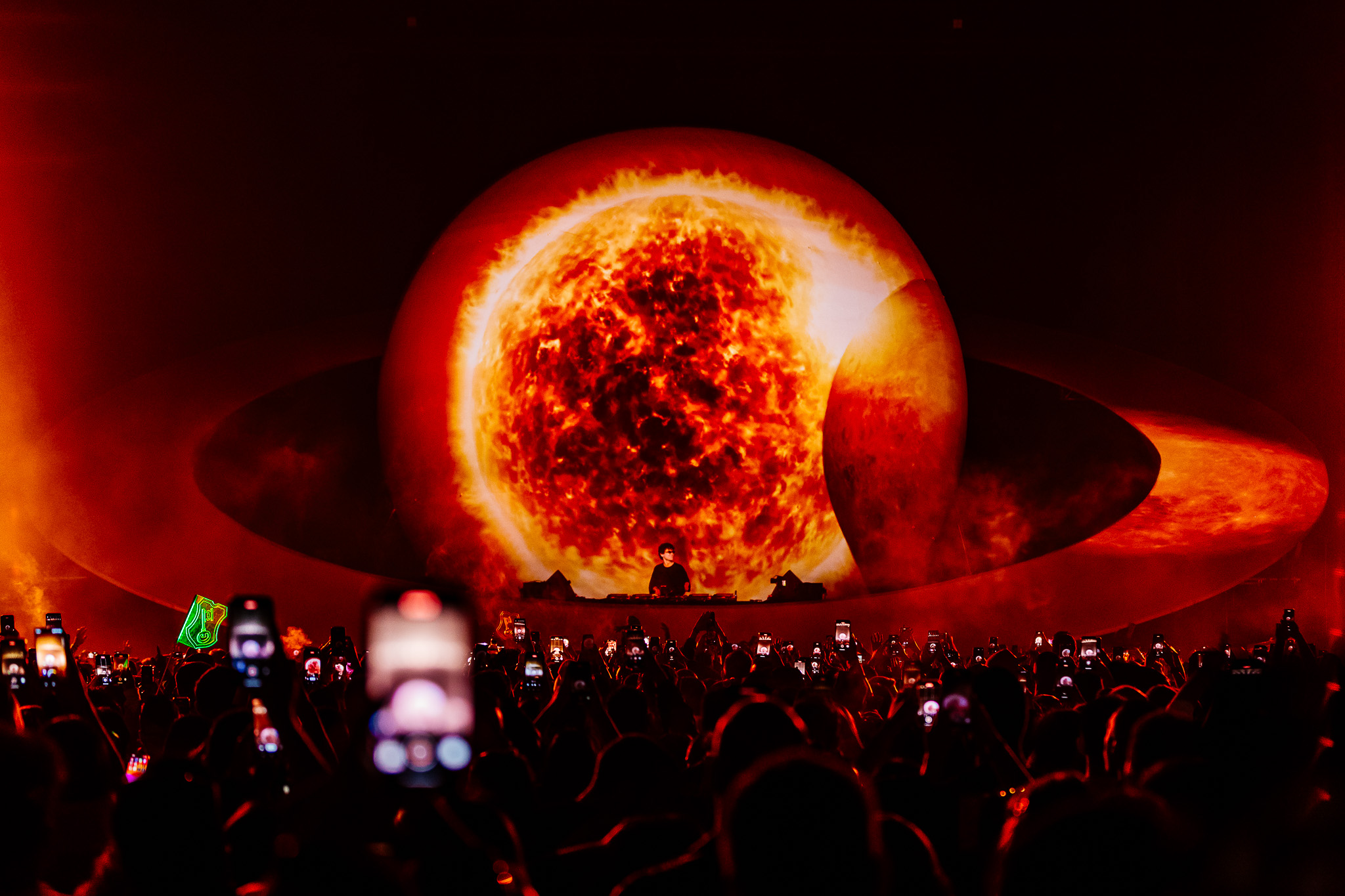
In the performance world, Christie’s pure laser devices created a model of Saturn and its rings for the Illusionize in Saturn electronic music party in Brazil. “LED has made significant inroads into this market and we’ll continue to see it used in new and creative ways,” Conover says. “Projection remains the primary display technology for many live events. However, we’re seeing a move away from the traditional approach of hanging projectors from the rafters without considering the total cost involved.”
Hire companies play a major role in the staging of shows of all types and, as Jay Petch, head of account management at Adlib, comments, are having to provide gear for stand-out events. “We’re seeing more shows and tours focused on creating a distinctive aesthetic, a unique ‘look’,” he says. “Recent advances in video-based technology have opened up more possibilities for designers, whether that’s harnessing the unique capabilities for specific fixtures, incorporating real-time AV-generated video content, or using creative stage set-ups such as lifts, automated rigging and winch systems.”
Companies with their roots in sound, like Adlib, are now branching out to offer other elements, including staging, rigging and video. But audio is still at the heart of live events and becoming even more crucial in creating a spectacle due to spatial technologies. “The live events market is evolving with a surge in immersive audio for concerts and stadium sports, where audiences expect exceptional sound delivered to every seat,” says Sarah Gellas, communications director at RG Jones Sound and Light. “In event production, clients are asking for a full 360-degree experience that blends live and digital.”
Gellas picks up on the point about sound systems having to work with the stage set, highlighting one aspect in particular: “The increasing trend in thrust stages has called for enhanced sound system design, including additional front fills as the artist often performs in front of the PA. That means ensuring every note reaches every seat with clarity.”
Bryan Grant, non-executive director of Britannia Row, agrees that the requirement today is for complex distributed audio systems featuring delay speaker hangs in the field and from the roof to ensure fans in the farthest seats have an optimal experience. “We are also expected to be able to duplicate at least the bulk of these systems in various territories to minimise freight costs and carbon footprint,” he says. “The Clair Global Group is represented by dozens of brands worldwide and serves a diverse range of clients. This means we have substantial equipment inventories with accompanying technical and administrative infrastructures in every major touring territory.”
Brit Row, in conjunction with Urban Audio, was on the 2025 Oasis tour, while Clair Global is out with Dua Lipa. Both deploy L-Acoustics systems, which, according to Paul McMullan, head of sales for Northern Europe, is seeing three major trends in audio right now: “Demand for immersive audio continues to accelerate, with, for example, Dua Lipa using our L-ISA system for special pop-up fan experiences in select cities. Sustainability has also become a market imperative, with younger audiences willing to pay premium prices for environmentally responsible events. As part of that, we have the L2 line array, which is small and more eco-conscious. Thirdly, small to medium-sized concert halls are investing in rider-friendly sound systems to attract better talent.”
On the touring side, Bradley Watson, sales director of Martin Audio, reports a great deal of growth in system sales across the UK and EU, with the former seeing a rapid increase in the number of new small to medium-sized rental companies. “These are supplying audio solutions to existing and new festivals and productions,” he says. “The delivery of sound is split between being visible and being augmented into set design.”
At HK Audio, application support engineer Karel Noon comments that sound equipment now must be far more flexible and visually unobtrusive. “Large stacks of loudspeakers are no longer acceptable at many events,” he says. “At the same time, in some communities, such as the techno and club scenes, the look of a speaker system can be part of the desired aesthetic. Audiences still want to have a great night out. The difference today is that with higher ticket prices, disappointment is less acceptable, so delivering high quality sound to every seat is crucial.”
A key part of this process is the infrastructure. cabling particularly. Herpreet Kaur Singh, commercial director of VDC Trading, a main agent for Van Damme cables, comments that specifiers and system designers are now looking for as much flexibility as possible, especially in these days of multiple formats for different aspect of a production. “Someone may say they need an AES cable but that it also has to be analogue and do DMX lighting control as well, all in one jacket,” she says. “And with the larger productions all doing huge video walls, we now have something in formulation that is one of the biggest innovations we’ve worked on this year and should be out soon.”
Supporting all of this are the stages, trusses, seats and steel constructions that make up not only the sets but also create a self-contained environment. “Demand for high-quality staging and seating continues to grow,” comments Katherine Herzog Parsons, chief executive of the Steeldeck Group. “Clients increasingly want modular, adaptable and design-led solutions. Temporary auditoria, risers and flexible staging are in demand not just for festivals and concerts but also for theatre, immersive experiences, fashion shows and corporate launches.”
Working with large, heavy metal structures and equipment can be dangerous, which is why, says Tom Harper, managing director of Unusual Industries, the biggest trend in rigging is the adjustment to industry standards. “These include an advisory standard, EN 17206, for stage machinery, which specifies what factor of safety you should be working towards when operating any sort of equipment or staging systems suspended over people, both the public and performers and crew,” he says. “The implications are that a lot of suppliers and automation and rigging companies are now obliged to update their kit.”
Harper adds that Unusual Industries invested a lot of money to facilitate its contribution to last year’s Paris Olympics, which included buying new hoists and moving equipment, conforming to the BGV D8+ standard for electric chain hoists. In the company’s other main area, theatre, Harper observes that productions have been getting “heavier and heavier”, which can be problematic in theatres built during the 1800s. “We’re dealing with stage engineering systems and legacy venues that don’t have the capacity to sustain a 30-ton show,” he says. “We are finding that a lot of the pre-fit-up requires us to go in with structural engineers and effectively build exoskeletons to ensure the system in the venue is robust enough to withstand the load of a show.”
With high powered stars such as Taylor Swift, Beyoncé and Robbie Williams continuing to raise the bar, backed by the clout of the corporate sector and the creative ambition of theatre, the show will clearly not only go on but continue to be bigger and more technologically elaborate.
adlib ⋅ Britannia Row Productions ⋅ Brompton technology ⋅ christie ⋅ Clair Global Group ⋅ d&b audiotechnik ⋅ RG Jones ⋅ ROE Visual ⋅ Steeldeck group ⋅ Unusual Industries
© 2025 Future Publishing Limited Quay House, The Ambury, Bath BA1 1UA. All rights reserved. England and Wales company registration number 2008885.