By Gosia Glinska
Business students today must be ready to lead amid constant change. Nowhere is that change more pronounced than in the technology sector, where rapid disruption is reshaping the industry itself and transforming the broader economy.
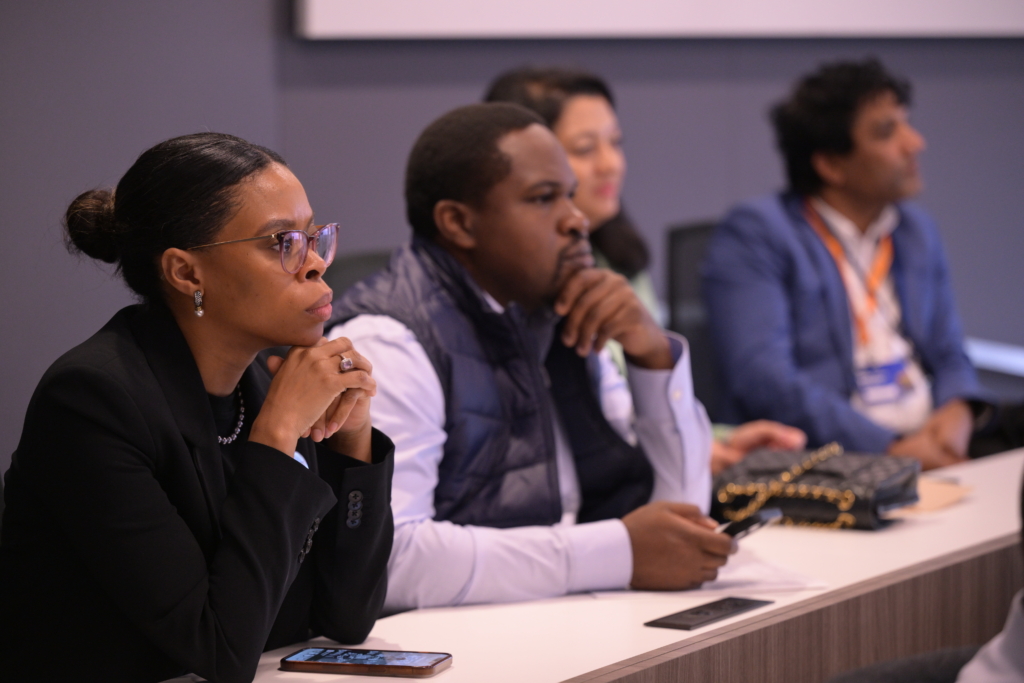
That was the backdrop—and the motivation—for the third annual DC Tech Connect, convened by Darden’s Batten Institute for Entrepreneurship, Innovation and Technology on 24 October at the Sands Family Grounds in the DC Metro area. The lively gathering of students, alumni and thought leaders from industry and academia explored the varied paths to making an impact in tech.
“The key to adding value and to future-proofing your career is to stay ahead of the curve and drive disruption, not merely react to it,” said Omar Garriott, the Batten Institute’s Executive Director, who also held leadership positions at tech companies such as Apple, LinkedIn, Salesforce and Qualtrics.
Across panels, podcasts, keynotes, a networking reception and a site visit to Amazon’s HQ2, one message rang clear: Success in the tech sector won’t be written in code alone. It will be shaped by human creativity, innovation and collaborative leadership.
Here are five career lessons for MBAs looking to break into—and rise within—the tech world.
For graduates hoping to get into the tech industry, relationships matter just as much as résumés.
“Your network is critical—it grows with every job you take,” said keynote speaker Seth Berl (UVA PhD ’20), Public Sector Strategy Director at Intel Corporation and former Deputy Chief Data Officer at the U.S. Department of Energy.
Keynote speaker Seth Berl (UVA PhD ’20) is the Public Sector Strategy Director at Intel Corporation, and former Deputy Chief Data Officer at the U.S. Department of Energy.
Alex Merida (MBA ’23), Senior Product Manager at Amazon Web Services, encouraged those without a technical background to discover what excites them and reach out to Darden alumni at tech companies of all sizes.
Said Merida, “Don’t just start with AWS, Microsoft, GitHub, and the like. Explore scale-ups, startups and pre-seed companies—where you can make an impact from day one.”
Merida emphasized that those environments empower you to wear multiple hats and develop technical skills organically. “If you join a pre-seed company, you might be helping build the next OpenAI and not even know it,” he said.
As many alumni noted, careers in tech rarely follow a straight or predictable path.
Meg Vorland (MBA ’16) got her start in politics before serving as a senior advisor at the U.S. Small Business Administration, where she worked on technology clusters across different regions. After earning her MBA from Darden, she co-founded Dcode, an accelerator firm. She later started Dcode Capital, a venture fund backing technology companies serving the U.S. federal government market.
Meg Vorland (MBA ’16) co-founded Dcode, an accelerator firm, and later started Dcode Capital, a venture fund backing technology companies serving the U.S. federal government market.
“My journey had lots of twists and turns,” said Vorland, “but I was always pretty set that I wanted to be in and around the tech industry.”
Brad Doss (MBA ’13), Senior Director of Revenue and Partner Marketing at GitHub, “kind of fell into tech.” After graduating from Darden, Doss continued his consulting career, during which GitHub became one of his clients. After several years of close collaboration with the company, GitHub offered Doss a job. As he put it, “If you had asked me a handful of years ago if I’d be in marketing, I would have said, ‘Absolutely not,’ and now I find myself leading several marketing teams.”
Garriott shared a career insight from his former boss, Steve Jobs. “You can’t connect the dots looking forward; you can only connect them looking backwards,” Jobs said during his famous commencement address at Stanford. He encouraged graduates to trust that their career choices will make sense in hindsight.
What does it take to succeed once you’ve landed the job? Across the board, alumni emphasized that an entrepreneurial mindset and skill set are essential for success. Whether you work at a scrappy tech startup or an industry giant, the ability to navigate uncertainty is key.
“In startup land, you’re trying to create something that doesn’t exist,” said Kevin Bennett (MBA ’12), serial entrepreneur and co-founder and CEO of Further, a firm that leverages AI and data analytics to make homeownership more accessible to first-time buyers. “There’s no roadmap.” Bennett noted that thinking clearly and making decisions under uncertainty—what he called “swimming in ambiguity”—is essential in fast-changing tech environments.
Even in established tech giants, “ambiguity is still the name of the game,” said James Freedman Aponte (MBA ’10), Senior Director of Business Product Marketing at Meta, who previously led strategy and operations at Google. “You’re not going to walk in and think, this stuff has been done repeatedly. There’s no recipe. You have a problem statement, a few numbers, and you’ve got to go figure it out.”
For Vorland, the standouts are those who don’t wait around for answers but figure things out on their own. “We call them ‘resilient hustlers,” she said. “At the SBA, I was the ‘get-stuff-done’ person—and I still am. Though I didn’t have a technical background, when we launched Dcode, I built the WordPress site myself, learning to code along the way.”
With technology evolving at an unrelenting pace, continuous learning has become essential. Berl underscored that staying relevant requires both curiosity and commitment. He hones his expertise by reading thought-provoking opinion pieces from industry leaders and through hands-on experimentation. Recently, he spent an entire night deploying and troubleshooting a real-time cloud data-streaming platform to grasp its inner workings. “I learned more in that one night of experimentation than I ever would from a product demo,” he said.
Maya Singh (MBA ’23), Product Manager at Microsoft’s Azure cloud computing platform, urged MBA students to “keep taking risks,” calling it a fast route to growth and learning. That philosophy meant seeking out hands-on, high-stakes experiences. “I worked for an early-stage startup — something that pushed me outside of my comfort zone,” she said. “Looking back, I wish I’d done even more of that while at Darden.”
Berl emphasized that artificial intelligence is no longer experimental. As he put it, “AI is fully operational across government, industry and academia, shaping real missions and influencing how people work and interact every day. It’s in analytics; it’s in everything.”
However, for all the excitement around AI, Garriott offered a sobering data point: 95% of enterprise AI projects show no return on investment. Companies are still trying to figure out how to make AI work for their business—and that gap is exactly where opportunity lies. “What’s the easiest way for businesses to figure it out?” asked Garriott. “Hire people who know what they’re doing with AI in job-specific use cases. Companies now expect to hire a one-plus-one, or maybe even a one-plus-five — you plus AI.”
His advice to MBAs? “Get super dangerous with AI while you have the time and space to do that.”
Speakers from left to right: Marc Ruggiano (MBA ’96) , Alex Merida (MBA ’23), Maya Singh (MBA ’23), Guy Maurice (MBA ’02 & Law ’03), Brad Doss (MBA ’13).
But what does “getting dangerous” actually mean? According to Guy Maurice (MBA ’02 & Law ’03), a Strategic Account Executive at Salesforce, generative-AI tools like ChatGPT, Gemini and NotebookLM are already part of daily work. “Today, you have to balance ongoing subject-matter expertise and AI skills training with staying ahead of your industry, while being a strategic advisor to your customers. Half of your job is staying on top of 1,000 different things every week,” he said. “Do you know how to prompt well? As students, you can bake that into your workflow and come out of school knowing how to leverage AI to be more productive, efficient and creative.”
Guy Maurice (MBA ’02 & Law ’03) (left) is a Strategic Account Executive at Salesforce. Brad Doss (MBA ’13) is the Senior Director of Revenue and Partner Marketing at GitHub
The productivity gains could be significant. Singh noted that using AI tools has made her more efficient and more customer-focused. “Writing product-requirement documents used to take a lot of time,” she said. “I now use Copilot for assistance, and it’s cut down my PRD writing time significantly. That’s given me more time to talk to customers and really understand their needs.”
Technology may power the modern world, but its true foundation is human connection. “Tech is still fundamentally about humans,” said Garriott. “Your long-term differentiator is how you engage people, drive ideas, and build relationships—not just to get the job, but to succeed in it.”
That truth informed Berl’s approach to developing the Department of Energy’s Enterprise Data Strategy. “Organizations often think technology will fix their problems,” he said. “But technology is not a silver bullet.”
Berl noted that true transformation begins with people. As DOE’s Senior Leader, he saw his role not just as developing a strategy, but as promoting data quality, governance, and security as essential drivers of mission success. Most importantly, he sought to inspire a vision that people could genuinely believe in.
Instead of imposing a top-down plan, Berl spent a year engaging over 200 leaders, practitioners, and scientists to co-create a vision rooted in data quality, governance and security. He built a data governance board and ensured every voice—from executives to engineers—shaped the outcome. “It wasn’t about architecture diagrams,” he noted. “It was about collaboration: We have to do this together.”
Berl’s experience demonstrates that transformative technology change hinges less on the tools themselves and more on understanding business processes, culture and human behavior.
In 2025, business education remains as relevant as ever. For Microsoft’s Singh, the value of her degree lies in the strategic thinking she practiced every day in the Darden classroom. “As AI takes over more of the day-to-day tasks, I have more time to think strategically,” she said. “The case method and the frameworks we learned, The Strategist’s Toolkit, teach you how to position a project in the market, craft a compelling story, and drive alignment across teams.”
According to GitHub’s Doss, the general-management perspective is what sets MBAs apart in tech. “You’re going to find people who are way smarter than you in their discipline—better engineers, better developers, better product managers,” he said. “But knowing enough on various functions and topics to be dangerous in a conversation, that’s invaluable, and many people in tech don’t have that.”
Another key insight from Doss’s MBA education was the vital importance of stakeholder management. “Darden’s leadership courses were also an essential piece of the puzzle,” he said. “All I do in my job today is deal with people. What you learn about working with others—bargaining and negotiating, managing conflict, hiring, acquisitions, even firing—those are things you typically learn on the job through many trials. And you’re going to get them wrong the first time unless you’ve studied them in advance.”
Meta’s Freedman Aponte credited his Darden experience with giving him the skills to manage through constant fires and uncertainty with calm and confidence. “In my Leading Organizations class,” he said, “I learned how to get a bunch of folks together into a discussion and drive toward an outcome. That’s exactly what I do now—bring the right people together and make decisions with incomplete information.”
For MBA graduates targeting tech careers, the message was clear: Combine your business acumen with AI proficiency, invest heavily in building relationships, embrace calculated risks and never stop learning. The tech sector needs what you bring—strategic thinking, a nuanced understanding of stakeholders, and the human skills that no algorithm can replicate or replace.
DC Tech Connect, held annually by the Batten Institute for Entrepreneurship, Innovation and Technology at Darden’s Sands Family Grounds, aims to strengthen Darden’s presence in the technology sector by connecting Darden students, alumni and industry partners invested in the DC tech ecosystem. Since its launch in 2023, the daylong event— featuring company visits, panel discussions, hands-on learning and a networking reception—has grown rapidly, drawing more than 150 tech innovators and leaders representing nearly 70 companies.
The University of Virginia Darden School of Business prepares responsible global leaders through unparalleled transformational learning experiences. Darden’s graduate degree programs (Full-Time MBA, Part-Time MBA, Executive MBA, MSBA and Ph.D.) and Executive Education & Lifelong Learning programs offered by the Darden School Foundation set the stage for a lifetime of career advancement and impact. Darden’s top-ranked faculty, renowned for teaching excellence, inspires and shapes modern business leadership worldwide through research, thought leadership and business publishing. Darden has Grounds in Charlottesville, Virginia, and the Washington, D.C., area and a global community that includes 20,000 alumni in 90 countries. Darden was established in 1955 at the University of Virginia, a top public university founded by Thomas Jefferson in 1819 in Charlottesville, Virginia.
Molly Mitchell
Senior Associate Director, Editorial and Media Relations
Darden School of Business
University of Virginia
MitchellM@darden.virginia.edu
Hoos for the Holidays: A Gift Guide from UVA Founders
Darden-Alum-Founded Rhoback Opens First Brick-and-Mortar Store in Charlottesville
Reimagining Entrepreneurship Education Through New Frontiers of Effectuation
Sign up for our newsletters to have Darden news delivered directly to your inbox. Select the news you’d like to receive below.
From B-School to Big Tech: Five Lessons for Success in the Technology Sector – Darden Report Online