14 minutes ago Leave a comment 6 Views
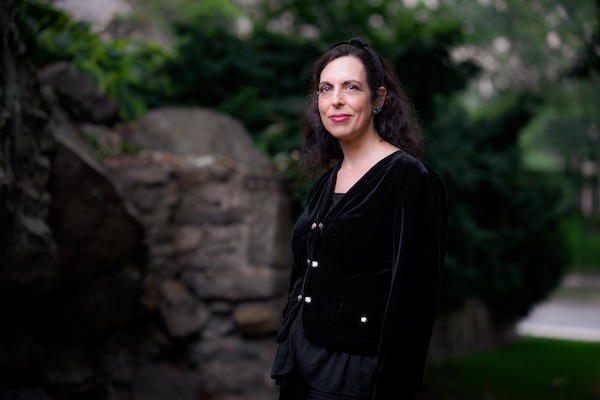
The 2026 laureates of the prestigious Azrieli Music Prizes were recently announced, and we’re speaking with each of the four winners about their music, their backgrounds, and the Prize. Most recently we heard from Adrian Mocanu. Today we’re delighted to present our interview with American composer Dalit Hadass Warshaw, who received the 2026 Azrieli Commission for Jewish Music.
Also a pianist and thereminist, Warshaw has been a fixture on the new-music scene for some time, earning much recognition along the way. A Goddard Lieberson Fellowship from the American Academy of Arts and Letters, three MacDowell Fellowships, and a Guggenheim Fellowship are just a few examples.
One of her many early-career accolades was a Fulbright Scholarship to Israel. Some of her many compositions reflect her Jewish background. But rarely has a project struck as close to home for the New York-based artist as the composition she is undertaking for the Azrieli Commission for Jewish Music. Letter from Across the River recounts a true story from the life of the composer’s great-grandfather in war-torn Poland, interwoven with the Biblical tale of Jacob’s struggle with the Angel.
I started out by asking the composer to talk about this piece.
You’ve frequently composed music on Jewish and Biblical themes, but Letter from Across the River reflects a family story of your own: that your great-grandfather swam across the River Bug in war-torn Poland to send a last letter to his sons, then returned to face his fate with the rest of his family. How will the music depict or evoke these events?
In striving to capture the tenor of locale, personalities, and story, I found myself coursing down a rabbit’s hole, compiling information as a fiction writer would in researching a novel.
I scoured monographs on the history and sociopolitical climate of the interwar period leading up to these events, memoirs of survivors, and literary works from prominent writers of the time, even undertaking a serious (and ongoing) study of Yiddish language and literature, at the YIVO Institute for Jewish Research.
All this said, I ultimately decided that my role as a composer is not necessarily to provide a sonic documentary, but to explore and convey what must have been a great internal struggle during my great-grandfather’s crucial, existential moment of choice. I convey his story through literary allegory, utilizing the Biblical scenario of Jacob wrestling the Angel as a foil for my great-grandfather’s own wrangling with self, and ultimate test of will.
Musically, I embody this struggle through highlighting potentials for contrast, not merely within the story itself (the choice between life and certain doom, freedom versus love and loyalty), but through my use of multiple languages (English, Hebrew and Yiddish), and the various ways that the instrumental and choral forces, and the soloists, spar with each other.
At various points I have the Yiddish and Hebrew vie with each other in the evocation of Jacob’s battle with the Angel, pitting the original Biblical Hebrew against the early-20th-century Yiddish translation by Solomon “Yehoash” Blumgarten.
At other times, the solo baritone wrangles with the chorus, [which] assumes the role of the River. The two vocal soloists oppose each other as well, in terms of their voice types, and the languages they sing: the baritone (representing my great-grandfather and singing in both English and Yiddish, at that time considered the mameh-loshen or “mother tongue”) and coloratura soprano (representing the Angel, singing solely in Hebrew, the loshen-koydesh, or the “Holy tongue”).
(Of personal significance to me, as a female composer, was the decision to reverse the traditional gender associations that were in place for each language at the time: In the shtetl, Hebrew was almost exclusively a men’s language, used solely in scholarly and religious contexts; women, due to their traditional lack of education, read and wrote solely in the vernacular Yiddish.)
Do you anticipate that your creative process might be different with this piece than with others, either musically or emotionally, because of the personal element?
What an excellent question.
On one hand, I would say no, simply [because] every topic or story that I’ve addressed through music has been one that has gripped me on some level, and that I’ve connected to deeply. In a way, this particular story is in keeping with a general theme in my work: to lend voice to those whose stories need to be told, and/or who may have been erased by history.
With all such prospects, I begin my process in a similar way: doing pre-compositional research, striving to internalize the contextual reality of whoever’s experience I will be conveying. As their reality becomes increasingly clear and vivid to me, so does my musical response, and a structural plan (or “musical narrative”) emerges, along with lots of sketching.
In this case, my connection to the protagonist of this story is obviously more overt, and the emotion, therefore, more immediate. Very specifically, in the earliest stages, I found myself studying the one surviving photograph of my great-grandfather, which is quite extraordinary, as one can truly observe his depth of character. Later in my research, I randomly happened upon his Polish signature, on a document recording the assignations of food rations in Dubienka in March 1939. I pored over the nature of his handwriting – flowing, graceful, meticulous – for a long time.
In addition to choir and orchestra, the 2026 AMP works can feature optional soloists. Will you incorporate either of your own instruments, piano or theremin, into the mix?
Absolutely! While I don’t believe I will include the piano – the sound world of the piece doesn’t really call for it – I adore the celesta, and it has enjoyed a prevalent role in much of my orchestral writing. I do plan on incorporating the theremin, an instrument that has such endless capacity for timbral blending within an orchestra, and one that – when mixed into the texture – can help to evoke vivid atmosphere, be it through the murkiness of its lower register, the dramatic swoops of its glissando, or the heavenly shimmer of its upper range. I plan to employ all elements within this piece, although will not be using the theremin soloistically.
Ten years ago I saw you play two Vocalises by Joseph Schillinger on the theremin at a New York Festival of Song tribute to Rachmaninoff and composers he crossed paths with in the city. You’re a New York City composer yourself. Have you always been based here? And how do you think the city has influenced your work?
How wonderful that you attended that very special concert! Yes, I am very much a New Yorker at heart, and have been based in NYC most of my life, with a few exceptions, including seven years in Boston (when I served on the composition faculty at the Boston Conservatory). I do believe that the city has influenced my work, although I could only have arrived at this conclusion after having lived elsewhere.
For one thing, New York is the only city I can think of (or, at least, that I have experienced thus far) in which there seems to be a true democracy of musical language: Regardless of one’s style or vocabulary, one can find one’s community [here], and one’s audience. All is aesthetically possible here.
The same can be said for one’s identity, in general. There is a freedom, a joy, a ready allowance for quirkiness, and a sense of acceptance that, along with its natural (if hyperbolic) freneticism, feeds and exhilarates me.
You teach at both Mannes and Brooklyn College while being a prolific composer. How do these two aspects of a music career inform each other?
Thank you for asking this question.
I find such delight in working with my composition students, and consider it an honor to probe aesthetic issues of importance and relevance with talented, passionate, and dedicated minds. It is also a great joy to revisit and analyze great musical works with my students, discovering new ones along the way.
I feel that, to truly teach, one is mandated to maintain one’s idealism toward one’s art, as one weighs carefully how to communicate about it to students. As far as I’m concerned, there is no ego or stylistic agenda involved, and I continually enjoy and marvel at how individual and diverse the musical voices of my students are.
Not to mention that, because composing is such a notoriously solitary enterprise, it is a genuine pleasure to discuss and explore the nuances of the composition process with them, after one has grappled with similar issues within one’s own work, often earlier that day! At its best, there is a wonderful symbiosis that occurs, and an exchange of energy, that is quite wonderful.
I learn from my students perpetually (not least, from their own musical influences, that run the gamut), and feel such gratification when I see them come into their own as strong, individual creative voices.
You’ve composed many pieces for orchestra, chamber ensembles, soloists, and vocalists, but only a handful for chorus. Is there anything about the particular subject matter of your new AMP composition that is especially well suited for chorus? Will you set the actual text of your great-grandfather’s letter?
First of all, the drama of the story itself seems to call for large forces, venturing beyond the individual solo voice. In this work, the chorus is, at various points, a Greek chorus, a chorus of angels, even the River itself!
Due to this incredible opportunity [that] I have to use chorus and two vocal soloists, I can truly play with the various permutations of how all components can interact: The baritone (who represents the protagonist, that is, my great-grandfather) can wrangle with the chorus in the way my great-grandfather would have struggled against the waves during his two traversals across the Bug River, and as Jacob would have battled the Angel.
Regarding the actual text of my great-grandfather’s letter: Unfortunately the letter itself does not seem to have survived. As a composer, the absence of words has actually proved somewhat liberating in that, out of necessity, I have been granted the license to conjure what might have been conveyed, beyond words, utilizing the language of music to evoke visceral emotional response.
The role of the theremin comes into play here, as this is an instrument capable of conjuring the otherworldly and, as it is featured here, the angelic and heavenly: While vocal in quality, it extends beyond human constraints, in terms of breath and range (and, of course, by the fact that it is electronic). Where words might have either failed or been lost, the theremin can take over, joining the soprano solo and women’s chorus at the end, in singing the Priest’s Blessing.
What does receiving the 2026 Azrieli Commission for Jewish Music mean for you and your work?
It is especially meaningful to receive this particular prize and commission. It is of the sort that serves to affect and inspire me every day, as I feel granted the “permission” to officially go forth more deeply along the trajectory that my work has taken me in recent years.
For one thing, to be enabled to express one’s creative vision, without having to compromise on practical elements such as instrumentation, is a composer’s dream.
Then, the prospect of receiving not “merely” one premiere of the new work, but three performances with three different orchestras, along with a commercial recording, is beyond wonderful, especially in light of the known difficulties in obtaining second performances of new orchestral works.
Of course, the monetary and professional support is so tremendously helpful and appreciated, as well.
Aside from all this, what may mean the most, on both personal and artistic levels, is that this commission is providing me the opportunity to reconcile the most elemental aspects of my identity: the ways in which I engage with language (including music!), with the past, and with the various cultural components that inform who I am, and, thus my means of expression.
Letter from Across the River will be performed at the Azrieli Music Prizes Gala Concert on October 15, 2026 and two subsequent international performances TBD. Hear more by Dalit Hadass Warshaw online.
Tags Azrieli Music Prizes 2026 Dalit Hadass Warshaw Dalit Warshaw theremin
4 hours ago
18 hours ago
6 days ago
“This is one of the reasons I’m so drawn to early music – it provides the temporal distance necessary to transform what we inherit into something new.”
Interview: Composer Dalit Hadass Warshaw, Winner of the 2026 Azrieli Commission for Jewish Music – Blogcritics