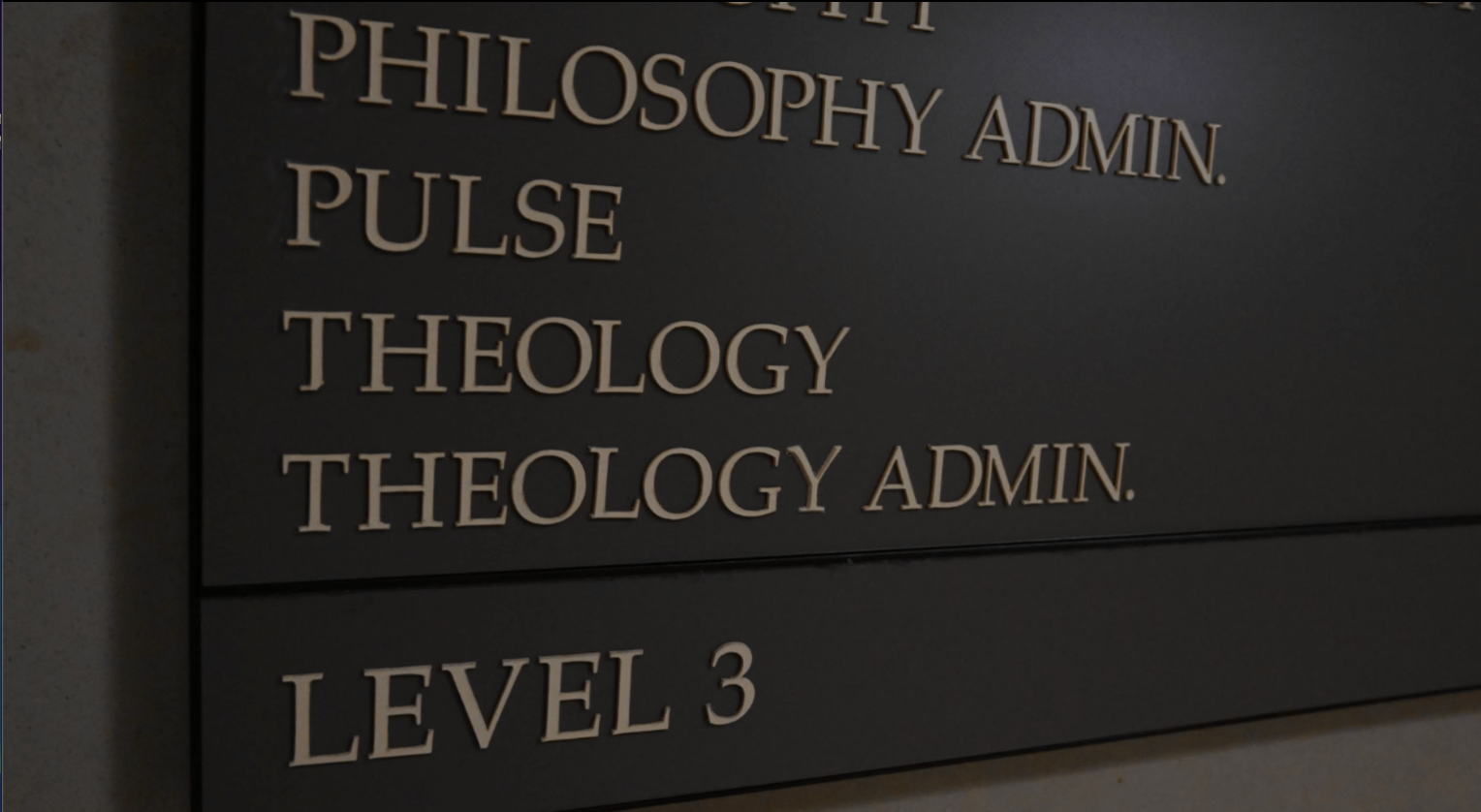
The theology department has announced a new minor in theology, science, and technology that aims to combine the humanistic approach of the Jesuit tradition with both scientific and technical fields.
“This is a minor that predisposes a willingness to integrate,” said Theology Department Chair Rev. Andrea Vicini, S.J. “What we learn in theology helps us to be ready to face the complex challenges in our world that we are experiencing.”
Vicini, the Michael P. Walsh professor of bioethics, describes the minor as one that is deeply rooted in the Jesuit tradition, a set of ideals he describes as marked by the intersectionality of disciplines with an eye for innovation.
“Jesuits have a very long tradition of combining the humanities and the sciences since the beginning,” Vicini said. “Personally, I’m a scientist and a theologian, so that unity for me is part of the way in which I—as a human being—experience a multiplicity of interests.”
Vicini is adamant about infusing a similar passion for interdisciplinary studies in those who pick up the minor.
“We are trying to help students in the minor to find ways to create that [interdisciplinary] unity while they deepen their interest throughout their college years,” Vicini said.
The minor will require students to complete 18 credits, including one laboratory science, one technology or applied science, two courses in science and technology in context, and one theology and science.
Applications for the minor open in January, with an initial cohort of 15 students.
Jeffrey Cooley, a pioneer of the minor along with Vicini and others, cites Boston College’s dedication to theology as an essential factor for the minor’s inception.
“I think BC’s historical commitment to theology on the one hand and its ever-growing investment in the sciences and engineering on the other have made the university an ideal location for this enterprise,” Cooley, an associate professor in theology, wrote to The Heights.
Cooley is confident that students will graduate from the minor with a broader, more reflective understanding of themselves and the courage to take on the world, citing the interdisciplinary capstone course as a catalyst.
“[The capstone] will provide a deliberative intellectual space in which students critically consider and reflect on their academic experiences in theology, science, and technology at BC up to that point,” Cooley wrote. “It will encourage them to thoughtfully prepare for their lives and vocations beyond their time at Boston College as undergraduates in the light of those experiences.”
In a similar vein, Vicini believes that students who participate in the minor will gain a broader view of the strands that connect many disciplines across the University, a skill that will benefit future leaders.
“We hope the students will further develop ways of seeing how what they do in a lab is not separate from what they can experience spiritually,” Vicini said. “The future leaders have to be able to create a synthesis between different disciplinary interests and then benefit from the diversity of different disciplines that, for many others, are separate.”
According to Cooley, the minor is best suited for any student who may feel compelled by its mission. He believes, however, that STEM-oriented students may gain the most from its lab and technology features.
“In principle, the program is suited for anyone who is curious or passionate about the intersection of theology, science, and technology,” Cooley wrote. “I imagine in many cases it will be simplest for students majoring in the natural sciences, global public health, pre-health programs, engineering, or computer science.”
To Vicini, the minor shouldn’t just be considered as a means for better educating the person, but also as a means of better serving those outside of oneself.
“We embrace the complexity of the world as creatures that have been created in order to find ways to be in this world and learn how it works, and also find ways to make it a better place for humankind,” Vicini said.
Cooley is confident the University’s strong pillars of progress, rooted in theology, allow students a premier opportunity for such a minor.
“At BC, we seek to find God in all things, and the minor will provide students with a distinctive path to pursue this search,” Cooley wrote.
The Heights use cookies to improve your experience on our site. By using our site, you consent to cookies.
Websites store cookies to enhance functionality and personalise your experience. You can manage your preferences, but blocking some cookies may impact site performance and services.
Essential cookies enable basic functions and are necessary for the proper function of the website.
These cookies are needed for adding comments on this website.
These cookies are used for managing login functionality on this website.
Statistics cookies collect information anonymously. This information helps us understand how visitors use our website.
Google Analytics is a powerful tool that tracks and analyzes website traffic for informed marketing decisions.
Service URL: policies.google.com (opens in a new window)
Marketing cookies are used to follow visitors to websites. The intention is to show ads that are relevant and engaging to the individual user.
Your email address will not be published.
Theology Department Unveils New Interdisciplinary Minor in Theology, Science, and Technology – bcheights.com