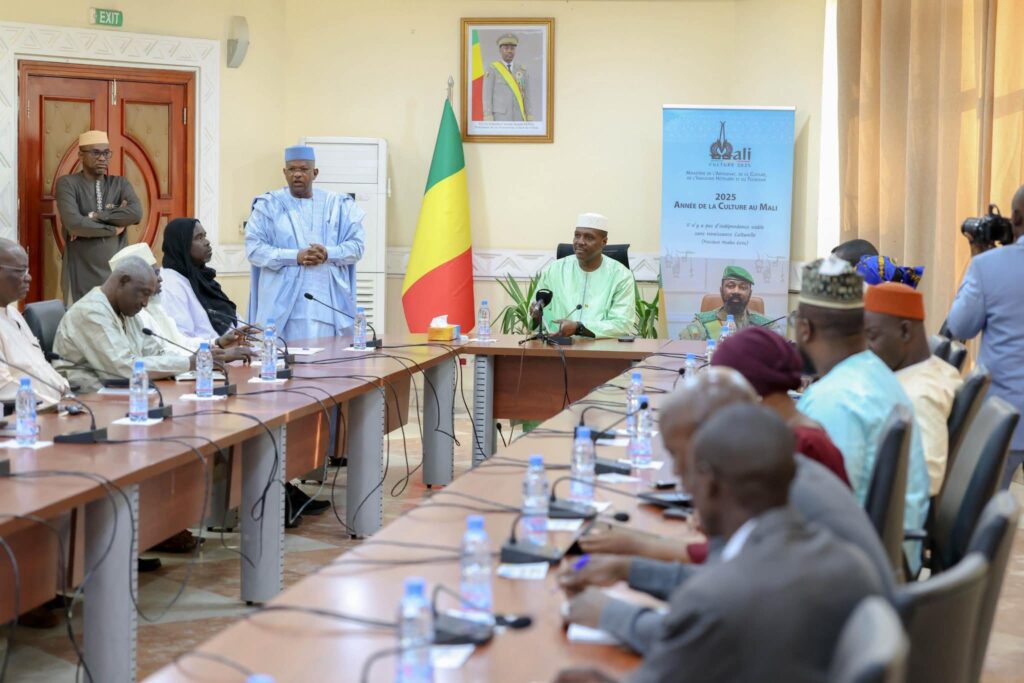
The Malian government, responding to a surge in inflammatory remarks aimed at spiritual figures, convened representatives of the country’s main religious denominations on Thursday.
Following the meeting, the executive branch announced the establishment of a dialogue framework designed to prevent verbal tensions from escalating into broader societal confrontations.
The meeting, chaired by Prime Minister Abdoulaye Maiga at his office, follows repeated warnings from both Muslim and Christian leaders who expressed deep concern over the increasing dissemination of aggressive messages across social media and certain public preaching spaces.
Authorities indicated that the targeted remarks—often anonymous and circulating on platforms difficult to control—are affecting both influential imams and church leaders. Prime Minister Maiga stressed that religious stability is a cornerstone of public peace and emphasized the urgent need for a political response to hate speech and behavior targeting religious figures in the rapidly evolving digital space.
He stated that the proposed consultation framework must anticipate, prevent, and address any behavior likely to undermine social cohesion.
The new committee will be formed through a participatory process, with religious leaders expected to play a crucial role in developing regulatory mechanisms. Representatives of the High Islamic Council (HCI) welcomed the initiative, acknowledging that new forms of digital communication require appropriate responses to maintain peace. HCI representative Macky Bah reiterated his organization’s willingness to support the process. Catholic and Protestant leaders also expressed full support, stressing the importance of having a neutral forum capable of intervening before tensions escalate into public confrontations.
For decades, religious leaders in Mali have served a critical role in social regulation, mediation, and political transitions. Authorities now fear that internal disputes, rivalries between preachers, or divergent doctrinal interpretations, once amplified online, could destabilize communities already strained by social tensions.
Analysts note that the increased visibility of new religious actors on the internet contributes to blurring traditional boundaries and weakening the internal mechanisms that once controlled religious discourse.
By bringing together all denominations, the government aims to restore a climate of trust and strengthen preventative measures. The success of this new framework will depend on its ability to stabilize a situation made increasingly fragile by the rise of digital platforms and the population’s commitment to preserving Mali’s complex social cohesion.
MD/ac/fss/abj/APA

This news portal is an aggregation of all its news sites powered in real time by a network of correspondents.
Based in each African country and in each of the largest capitals in Europe, Asia and the Americas.
Type above and press Enter to search. Press Esc to cancel.
Mali creates dialogue framework after threats to religious figures – APAnews – Agence de Presse Africaine