
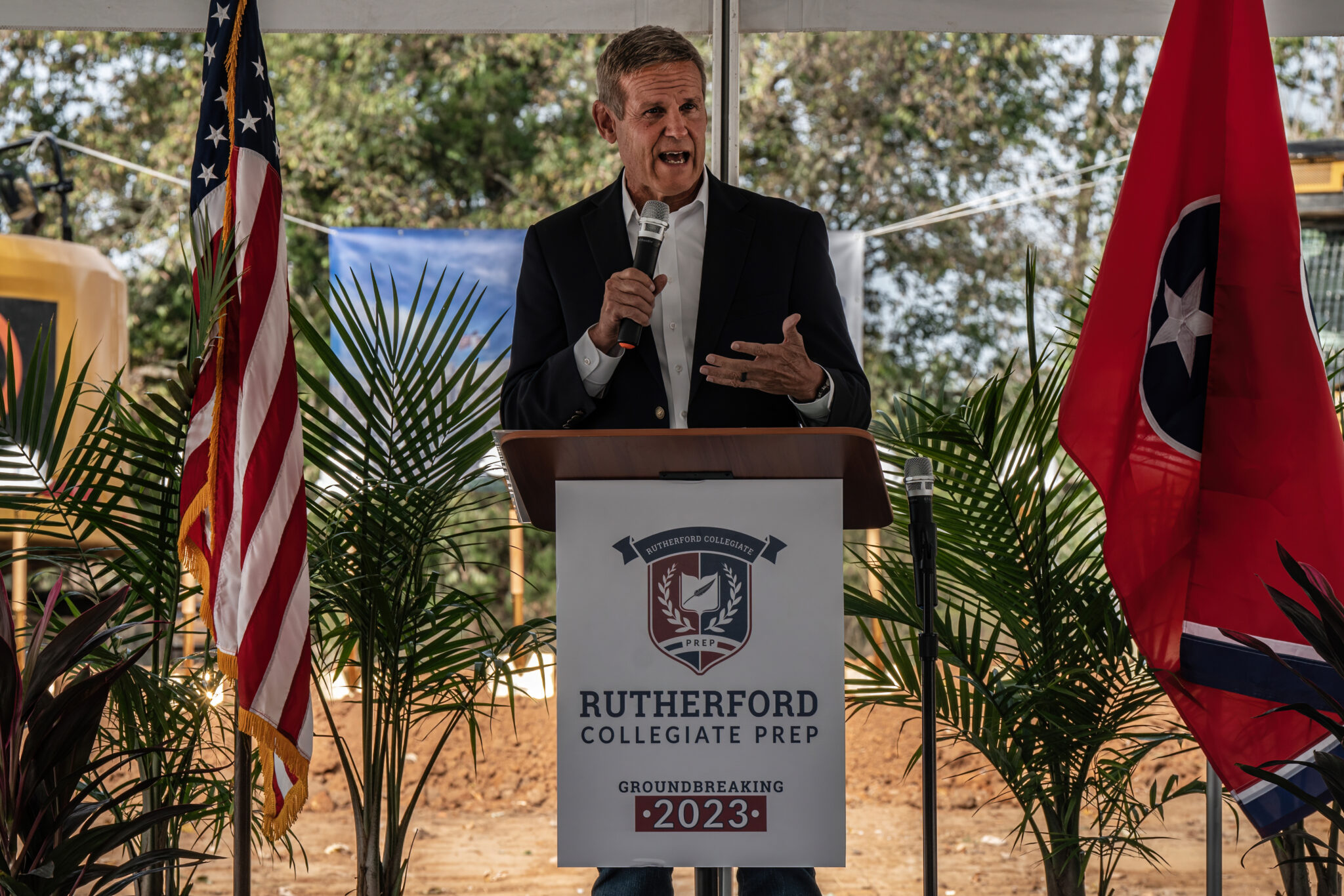
Gov. Bill Lee, photographed at the groundbreaking for a Rutherford County charter school in 2023, spurred the creation of a state board authorizing charter schools. (John Partipilo/Tennessee Lookout)
That crumbling sound you hear is not the Tennessee Vols defense falling apart brick by brick. That was more of an implosion against Vandy last weekend at Neyland Stadium.
No, this is the gradual dismantling of the “wall of separation between church and state.”
The latest disassembly involves an opinion by Tennessee Attorney General Jonathan Skrmetti saying the state’s prohibition on religious-based charter schools “likely” violates the free exercise of religion in the First Amendment.
Skrmetti wrote the opinion at the request of Republican state Rep. Michelle Carringer of Knoxville who has a bill relating to charter schools. Carringer said Thursday she requested the opinion for “legal clarity” on the relationship between the Constitution and Tennessee charter laws but has no plans to bring legislation related to it.
The opinion, which is not binding, points out state law requires public charter schools “to operate as … nonsectarian [and] nonreligious.” Similarly, another state law prohibits bodies that “promote the agenda of any religious denomination or religiously affiliated entity” from sponsoring a charter school.
“Those restrictions exclude otherwise qualified religious entities from participating in a public benefit, and no compelling interest is apparent,” the opinion says. Thus, the state’s restrictions “likely violate the free exercise clause.”
This leap of faith is supported by three U.S. Supreme Court decisions after a case called Oklahoma Statewide Charter School Board v. Drummond left the question unresolved, according to the opinion. The court was divided on that matter, and Justice Amy Coney Barrett recused herself.
The trio of rulings found that “excluding religious entities from a public benefit ‘solely because of their religious character’ penalizes (religious freedom) and triggers ‘the most exacting scrutiny,’” the opinion says.
In applying those decisions, the attorney general concluded Tennessee’s exclusion of religious charter school sponsors “likely” violates the free exercise clause in the First Amendment to the U.S. Constitution.
The relationship between charter schools and public school boards is sketchy at best. Metro Nashville’s school board has turned down several charter requests, mainly because of concerns that the charters wouldn’t serve all students, only to see its decisions reversed at the state level.
Under Gov. Bill Lee, the legislature formed a charter school authorizing board that has the final say on the formation of charters, which are run by nonprofit entities using public dollars and, often, public buildings. In the last three years, the state put about $67 million into charter facilities.
This blurring of lines between government and religion is nothing new around these parts. Lee started the Governor’s Office of Faith-based Initiatives, and the legislature began pouring millions into it three years ago. The total is up to $4.5 million, with about three-fourths of that going to staff.
In addition, Tennessee is doling out $144 million for a private-school voucher program, essentially an entitlement program involving religious schools across the state.
Any time someone brings up the “wall of separation between church and state,” folks argue that those words aren’t in the Constitution. They’re right. It’s only a principle designed to keep dratted politicians from controlling religion.
The U.S. Supreme Court decided more than 75 years ago that the wall “must be kept high and impregnable.”
The question is whether Tennessee will use a stick of dynamite to blow it up or a sledgehammer to knock it down brick by brick. Either way, it seems to be falling.
Two East Tennessee families represented by EdChoice Legal Advocates want to defend the state’s private-school voucher program, filing a motion seeking to intervene in a case challenging its legality. The Beacon Center of Tennessee is representing the parents as well.
The state is defending itself against a lawsuit claiming the program is unconstitutional because it diverts money from public education.
The program provides $7,300 per child to attend private schools, $144 million for 20,000 children this year, and that number could rise in 2026.
EdChoice said in a release this week the families of Denise Fair of Jefferson City and Mike and Monica Sweeney of Knoxville depend on the program to put their children in learning environments that meet their families’ “moral values.” Otherwise, they would face “significant financial hurdles.”
“Behind every legal filing are real children whose futures hang in the balance. This lawsuit threatens to take choices away from families who have done everything right – families who simply want to place their children in the learning environments where they can thrive,” said Thomas Fisher of EdChoice Legal Advocates.
The Sweeneys’ three children are using the vouchers to pay for tuition at a Catholic school this year after homeschooling them because they didn’t like pandemic procedures at their school.
Fair and her husband, who are first responders, worked extra jobs to send two of their six children to a Christian school. The state funding “eased that burden,” according to the release, and allowed them to keep their two girls at Lakeway Christian Academy and cut back on part-time work.
“It has allowed me more time to dedicate to attending activities with the girls and freed up enough financial resources to allow the girls to attend some school field trips,” Denise Fair said in a release.
A court ruling against the program would put “a real financial burden” on the family and keep them from affording Lakeway Christian’s tuition, she said.
Thank you for the honesty.
The state’s own financial impact analysis showed 66% of those likely to receive the vouchers were attending private schools already (Gov. Lee prefers “scholarships” even though students don’t have to earn them).
This appears to be a point of contention, because the state Department of Education won’t disclose how many of the 20,000 students receiving the money really were enrolled in private schools already, probably because it’s closer to 90%.
The demand is there, according to the governor, so the program must be expanded. He has said repeatedly his main concern is that more “scholarships” aren’t available.
Maybe it’s time to shift that concern. In the words of some worry warts, have you ever seen an entitlement program shrink or disappear?
Maybe it’s time for the state to dispense with the niceties and stop the public schools charade. Whether it’s called a voucher or a scholarship, just give everyone a few thousand bucks and let them fend for themselves.
We need to toughen up anyway.
A group of nearly 20 Tennessee medical professionals is asking the governor to pause executions until a court can review the state’s new execution protocol, which depends on the drug pentobarbital.
The group sent a letter to Lee this week urging him to hold up on the next execution set for Dec. 11 to give the courts more time to handle a death row lawsuit over the protocol. A coalition of media also filed suit to gain more access to executions.
The medical professionals’ letter points out Lee stopped all executions in 2022 because of concerns about the protocol for lethal injections and ordered an independent investigation. The Department of Correction came up with a new lethal injection protocol last January that relies solely on pentobarbital, “and we have grave concerns about this unreviewed method,” their letter says.
The group of medical professionals isn’t taking a stance on capital punishment but says the use of pentobarbital “creates a serious risk of a prolonged, agonizing death. It also exposes Tennessee’s correctional officers to chaotic and psychologically harmful executions,” the letter says.
An Associated Press reporter who witnessed the execution of Byron Black in August said at one point the inmate moved his head around once or twice off a gurney, exhaled a couple of times and told his spiritual advisor, “Oh it hurts so bad.”
The 69-year-old Black, the first person executed since the new protocol took effect, was wheelchair-bound and suffering from dementia, brain damage, kidney failure and congestive heart failure, according to his attorneys. He was executed for the 1988 murder of his girlfriend and her two young daughters.
The Nashville Banner also reported it took about 10 minutes to put an IV in Black’s arm, causing a puddle of blood to form on his right side.
Asked in September whether his administration would investigate problems with Black’s execution, Lee said no.
Less than 48 hours after capturing the 7th Congressional District seat in a special election, Republican Matt Van Epps was sworn into office in Washington, D.C., using his daughter’s pink Bible for the ceremony.
Van Epps, a former Tennessee commissioner of General Services and Army special operations helicopter pilot, said, “America’s strength comes from our enduring belief that freedom is worth fighting for and from our commitment to protect and empower the hard-working families who make the American dream possible,” according to an Associated Press report. He also promised to help enact President Donald Trump’s “America First” agenda after defeating Democratic state Rep. Aftyn Behn by 9 percentage points. The margin of victory dipped just a tad from former U.S. Rep. Mark Green’s typical 20-plus-point wins.
Van Epps’ victory was critical in helping Republicans maintain a majority in the U.S. House as it copes with critical issues such as the Epstein files and an investigation into the bombing of an alleged drug smuggling boat off the coast of Venezuela. Hitting the vessel twice would have been illegal.
It’s amazing how fast the federal government can work when control is on the line.
“Nobody gonna beat my car / It’s gonna break the speed of sound.”
*Deep Purple, “Highway Star”
GET THE MORNING HEADLINES.
by Sam Stockard, Tennessee Lookout
December 5, 2025
by Sam Stockard, Tennessee Lookout
December 5, 2025
That crumbling sound you hear is not the Tennessee Vols defense falling apart brick by brick. That was more of an implosion against Vandy last weekend at Neyland Stadium.
No, this is the gradual dismantling of the “wall of separation between church and state.”
The latest disassembly involves an opinion by Tennessee Attorney General Jonathan Skrmetti saying the state’s prohibition on religious-based charter schools “likely” violates the free exercise of religion in the First Amendment.
Skrmetti wrote the opinion at the request of Republican state Rep. Michelle Carringer of Knoxville who has a bill relating to charter schools. Carringer said Thursday she requested the opinion for “legal clarity” on the relationship between the Constitution and Tennessee charter laws but has no plans to bring legislation related to it.
The opinion, which is not binding, points out state law requires public charter schools “to operate as … nonsectarian [and] nonreligious.” Similarly, another state law prohibits bodies that “promote the agenda of any religious denomination or religiously affiliated entity” from sponsoring a charter school.
“Those restrictions exclude otherwise qualified religious entities from participating in a public benefit, and no compelling interest is apparent,” the opinion says. Thus, the state’s restrictions “likely violate the free exercise clause.”
This leap of faith is supported by three U.S. Supreme Court decisions after a case called Oklahoma Statewide Charter School Board v. Drummond left the question unresolved, according to the opinion. The court was divided on that matter, and Justice Amy Coney Barrett recused herself.
The trio of rulings found that “excluding religious entities from a public benefit ‘solely because of their religious character’ penalizes (religious freedom) and triggers ‘the most exacting scrutiny,’” the opinion says.
In applying those decisions, the attorney general concluded Tennessee’s exclusion of religious charter school sponsors “likely” violates the free exercise clause in the First Amendment to the U.S. Constitution.
The relationship between charter schools and public school boards is sketchy at best. Metro Nashville’s school board has turned down several charter requests, mainly because of concerns that the charters wouldn’t serve all students, only to see its decisions reversed at the state level.
Under Gov. Bill Lee, the legislature formed a charter school authorizing board that has the final say on the formation of charters, which are run by nonprofit entities using public dollars and, often, public buildings. In the last three years, the state put about $67 million into charter facilities.
This blurring of lines between government and religion is nothing new around these parts. Lee started the Governor’s Office of Faith-based Initiatives, and the legislature began pouring millions into it three years ago. The total is up to $4.5 million, with about three-fourths of that going to staff.
In addition, Tennessee is doling out $144 million for a private-school voucher program, essentially an entitlement program involving religious schools across the state.
Any time someone brings up the “wall of separation between church and state,” folks argue that those words aren’t in the Constitution. They’re right. It’s only a principle designed to keep dratted politicians from controlling religion.
The U.S. Supreme Court decided more than 75 years ago that the wall “must be kept high and impregnable.”
The question is whether Tennessee will use a stick of dynamite to blow it up or a sledgehammer to knock it down brick by brick. Either way, it seems to be falling.
Two East Tennessee families represented by EdChoice Legal Advocates want to defend the state’s private-school voucher program, filing a motion seeking to intervene in a case challenging its legality. The Beacon Center of Tennessee is representing the parents as well.
The state is defending itself against a lawsuit claiming the program is unconstitutional because it diverts money from public education.
The program provides $7,300 per child to attend private schools, $144 million for 20,000 children this year, and that number could rise in 2026.
EdChoice said in a release this week the families of Denise Fair of Jefferson City and Mike and Monica Sweeney of Knoxville depend on the program to put their children in learning environments that meet their families’ “moral values.” Otherwise, they would face “significant financial hurdles.”
“Behind every legal filing are real children whose futures hang in the balance. This lawsuit threatens to take choices away from families who have done everything right – families who simply want to place their children in the learning environments where they can thrive,” said Thomas Fisher of EdChoice Legal Advocates.
The Sweeneys’ three children are using the vouchers to pay for tuition at a Catholic school this year after homeschooling them because they didn’t like pandemic procedures at their school.
Fair and her husband, who are first responders, worked extra jobs to send two of their six children to a Christian school. The state funding “eased that burden,” according to the release, and allowed them to keep their two girls at Lakeway Christian Academy and cut back on part-time work.
“It has allowed me more time to dedicate to attending activities with the girls and freed up enough financial resources to allow the girls to attend some school field trips,” Denise Fair said in a release.
A court ruling against the program would put “a real financial burden” on the family and keep them from affording Lakeway Christian’s tuition, she said.
Thank you for the honesty.
The state’s own financial impact analysis showed 66% of those likely to receive the vouchers were attending private schools already (Gov. Lee prefers “scholarships” even though students don’t have to earn them).
This appears to be a point of contention, because the state Department of Education won’t disclose how many of the 20,000 students receiving the money really were enrolled in private schools already, probably because it’s closer to 90%.
The demand is there, according to the governor, so the program must be expanded. He has said repeatedly his main concern is that more “scholarships” aren’t available.
Maybe it’s time to shift that concern. In the words of some worry warts, have you ever seen an entitlement program shrink or disappear?
Maybe it’s time for the state to dispense with the niceties and stop the public schools charade. Whether it’s called a voucher or a scholarship, just give everyone a few thousand bucks and let them fend for themselves.
We need to toughen up anyway.
A group of nearly 20 Tennessee medical professionals is asking the governor to pause executions until a court can review the state’s new execution protocol, which depends on the drug pentobarbital.
The group sent a letter to Lee this week urging him to hold up on the next execution set for Dec. 11 to give the courts more time to handle a death row lawsuit over the protocol. A coalition of media also filed suit to gain more access to executions.
The medical professionals’ letter points out Lee stopped all executions in 2022 because of concerns about the protocol for lethal injections and ordered an independent investigation. The Department of Correction came up with a new lethal injection protocol last January that relies solely on pentobarbital, “and we have grave concerns about this unreviewed method,” their letter says.
The group of medical professionals isn’t taking a stance on capital punishment but says the use of pentobarbital “creates a serious risk of a prolonged, agonizing death. It also exposes Tennessee’s correctional officers to chaotic and psychologically harmful executions,” the letter says.
An Associated Press reporter who witnessed the execution of Byron Black in August said at one point the inmate moved his head around once or twice off a gurney, exhaled a couple of times and told his spiritual advisor, “Oh it hurts so bad.”
The 69-year-old Black, the first person executed since the new protocol took effect, was wheelchair-bound and suffering from dementia, brain damage, kidney failure and congestive heart failure, according to his attorneys. He was executed for the 1988 murder of his girlfriend and her two young daughters.
The Nashville Banner also reported it took about 10 minutes to put an IV in Black’s arm, causing a puddle of blood to form on his right side.
Asked in September whether his administration would investigate problems with Black’s execution, Lee said no.
Less than 48 hours after capturing the 7th Congressional District seat in a special election, Republican Matt Van Epps was sworn into office in Washington, D.C., using his daughter’s pink Bible for the ceremony.
Van Epps, a former Tennessee commissioner of General Services and Army special operations helicopter pilot, said, “America’s strength comes from our enduring belief that freedom is worth fighting for and from our commitment to protect and empower the hard-working families who make the American dream possible,” according to an Associated Press report. He also promised to help enact President Donald Trump’s “America First” agenda after defeating Democratic state Rep. Aftyn Behn by 9 percentage points. The margin of victory dipped just a tad from former U.S. Rep. Mark Green’s typical 20-plus-point wins.
Van Epps’ victory was critical in helping Republicans maintain a majority in the U.S. House as it copes with critical issues such as the Epstein files and an investigation into the bombing of an alleged drug smuggling boat off the coast of Venezuela. Hitting the vessel twice would have been illegal.
It’s amazing how fast the federal government can work when control is on the line.
“Nobody gonna beat my car / It’s gonna break the speed of sound.”
*Deep Purple, “Highway Star”
GET THE MORNING HEADLINES.
Tennessee Lookout is part of States Newsroom, a nonprofit news network supported by grants and a coalition of donors as a 501c(3) public charity. Tennessee Lookout maintains editorial independence. Contact Editor Holly McCall for questions: info@tennesseelookout.com.
Our stories may be republished online or in print under Creative Commons license CC BY-NC-ND 4.0. We ask that you edit only for style or to shorten, provide proper attribution and link to our website. AP and Getty images may not be republished. Please see our republishing guidelines for use of any other photos and graphics.
Sam Stockard is a veteran Tennessee reporter and editor, having written for the Daily News Journal in Murfreesboro, where he served as lead editor when the paper won an award for being the state’s best Sunday newspaper two years in a row. He has led the Capitol Hill bureau for The Daily Memphian. His awards include Best Single Editorial and Best Single Feature from the Tennessee Press Association.
Tennessee Lookout is part of States Newsroom, the nation’s largest state-focused nonprofit news organization.
DEMOCRACY TOOLKIT
© Tennessee Lookout, 2025
v1.97.9
Now more than ever, tough and fair journalism is important. The Tennessee Lookout is your watchdog, telling the stories of politics and policy that affect the people of the Volunteer State.
We’re part of States Newsroom, the nation’s largest state-focused nonprofit news organization.
Our stories may be republished online or in print under Creative Commons license CC BY-NC-ND 4.0. We ask that you edit only for style or to shorten, provide proper attribution and link to our website. (See full republishing guidelines.)
© Tennessee Lookout, 2025