documentaries interviews Kickstarter Kickstart This! reviews Sundance 2020 Sundance 2021 Sundance 2023 Sundance 2025 SXSW 2013 SXSW 2021 SXSW 2023 The Moveable Fest TIFF 2019 TIFF 2022 TIFF 2023 TIFF 2025 Tribeca 2021 Tribeca 2022 Tribeca 2025
Towards the end of Mona Fastvold’s 2022 film “The World to Come,” it could appear as if she was having an epiphany as her characters were when a climax was constructed around the turning of book pages as a faster and faster clip, mirroring the passion that couldn’t be held in any longer by Abigail (Katherine Waterston) and Tallie (Vanessa Kirby) as they gave into what their hearts were telling them in spite of their surroundings on the American frontier in the 1800s. The quick-cut montage may have actually exceeded the pace of the women’s hearts racing, so overwhelming that it could yield a truly transcendent feeling of ecstasy.
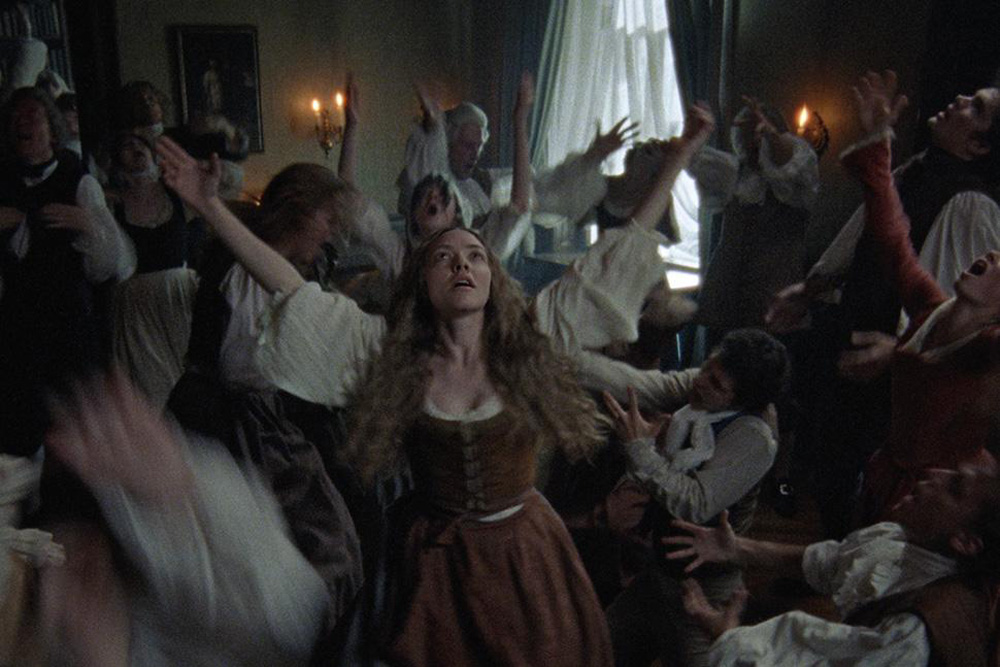
“The Testament of Ann Lee,” about a woman who finds God, seems like a fitting follow-up when Fastvold placed within her grasp a sensation that seems out of reach for so many others and while the director seems skeptical of religion itself, she has created an altar at the cinema when the musical with original songs from Daniel Blumberg and choreography from Celia Rowlson-Hall summons a irrational and enveloping fervor that makes it understandable why Lee, played by a magnificent Amanda Seyfried, would give herself over to the Shaker movement of the 18th century so fully and freely.
The film can be read as a black comedy where the inky compositions are dripping with irony as Ann, disgusted by her parents’ flagrant fornication right in front of her as a young girl and a subsequent coupling with a blacksmith (Christopher Abbott) like her father that yields four pregnancies that end in tears, lead her towards a religion that embraces celibacy, which would be fine if she wasn’t such a true believer that wanted to spread the faith to America without thinking how expansion is somewhat of a dead end when procreation isn’t an option to extend it into future generations. Still, Ann’s own personal connection to the divine isn’t mocked and a purity of belief is reflected in the strength of her voice, with the temptation to join her in every bewitching song in the film. Though her reasons for starting the religion may be misguided, the effects of it are positive when she gives a sense of belonging to all, believing a utopia can only exist upon accepting of everyone else and fashioning a faith free of the sexism and racism she sees elsewhere.
Ultimately, it may not be an almighty individual that Ann trusts but rather the power of a collective, which Fastvold surely has in common with her lead when learning of the spirit of collaboration that’s said to run throughout one of her productions. Not only did the director involve Blumberg and Rowlson-Hall early on in the gestation of “The Testament of Ann Lee,” but also editor Sofia Subercaseaux, a longtime friend that she had yet to collaborate with (though their husbands Brady Corbet and Antonio Campos, respectively, had worked with each other for years, most notably on the 2012 thriller “Simon Killer”). If Fastvold had discovered something sensational in the edit of “The World to Come,” it is pushed even further by Subercaseaux, who first came to prominence making sense of the madness in the comedies of fellow Chilean Sebastian Silva and could be counted on to show remarkable patience in the intricate dramas of Campos (“Christine”) and Pablo Larrain (“Maria”). “Ann Lee” calls on both ends of Subercaseaux’s considerable skillset when she can readily summon the fever dreams that Ann has as she taps into the sublime with kinteticism, but adds to the scale of not only the main character’s experience but that of an audience when judiciously cutting from her to the world around her to feel its totality, making the small-scale production feel grand when reflecting that everything and everyone there serves a purpose.
With the film now in theaters following premieres at Venice and Toronto earlier this fall, Subercaseaux spoke of the kind of creative environment that Fastvold cultivates, the critical role she had in the making of “The Testament of Ann Lee,” which recently earned her a Spirit Award nomination, and the challenges and rewards of working on her first musical.
I suspect you and Mona have known each other for some time, so it was surprising that this was the first time you had actually worked together. What made this the right opportunity?
We’ve been very good friends for a long time and we’ve always talked about working together. Because we just see each other socially a lot, we were just all constantly talking about [“The Testament of Ann Lee”] and I read the script early on. For different reasons, [a collaboration] just didn’t happen and now this time we could make it happen, which was so exciting.
We were just having conversations about my impressions of the script, but it’s funny with this script because of the music and the dance numbers, you truly couldn’t get a sense of what that was going to be until I got the footage. The script is beautiful, but you can’t write a dance number. You can describe it loosely, but it can’t have the emotional weight that it has on the screen. So a truly big surprise happened when I started getting the footage and I [said to] Mona, “What is this? It’s amazing.” I had seen footage of the rehearsals of the dance because I’m also good friends with Celia [Rowlson-Hall], the choreographer, and of course I was listening to the music that they were recording with Daniel [Blumberg, the composer], but I love that part about my job is you never truly get a sense of what the director is up to until you start getting the footage. That was very much the case in this situation.
Like “The Brutalist,” this looks epic despite what I understand is a very spartan budget. Does that mean there’s not actually a lot of takes to go through, especially when it’s shot on celluloid?
Just given the time constraints, they’re very clear directors. They don’t go on an experiment, so they know what they’re getting [on set]. It just wouldn’t be possible to shoot these huge movies for the amount of money they shoot them in these time constraints if you were discovering the movie as you go, so it’s not like there’s two takes, but there’s not 20. Sometimes they just get it on the first one and that’s it and there is more choreographed stuff that needs to be precise and they do it until they got it, but usually, it’s very clear. The big burn scene, you can only burn that house once, so they had a ton of coverage for that one, which is unusual. They’re very good [at shot selection]. If you move the camera that way, it doesn’t look good. It’s a real talent to be able to shoot that [specifically] and make it look good because you need to know exactly where to plant the camera for it to look the way it looks.
But the footage that you get as an editor is just very concise. I remember getting the first big dance sequence — that crazy one inside the house — which came very early on in the edit, and my jaw dropping. [The scene is] exactly what’s in the movie. There’s nothing else. They tweaked the color slightly, but that’s what I got and I remember just being so blown away by it. Then putting that whole thing together and then Daniel would start sending like the mixes and then the music starts sounding like what it actually sounds [like in the final cut].
Were you locked into certain things just because of the way it was shot or because of the music? From what I understand, even the most choreographed scenes did have different potential versions.
There were certain things that were always going to be locked in, like the first big dance sequence. That’s one take and there’s one stitch that’s not really a stitch, but it changes a shot to the side and it was just about getting the right take, so I knew that was going to happen. Luckily, it worked because sometimes things don’t work and you need to get creative. The other [sequences] were just very free. We knew how we wanted them to feel.
I’ve never done a musical or something like this, so what I ended up doing, which proved to be very helpful, is that I would get the best shots of each choreography [of a sequence] and line them up one after the other on top of each other on the timeline, [connected by the actors] singing to the music. Then we would watch each take, single it out and mark the good parts of each take and get rid of the rest. It was like Tetris, finding out “Okay, this moment goes here.” Then it’s not so different from how you build on anything, which is that you find the moment that you know has to be there and then you build around it. We started finding that there were very small delays because each take has its own [momentum] and you’re doing a take, then another [take] and you get to one movement just a second later and that became a kind of language of switching to the next take and doing the movement again and then we began leaning into that as opposed to trying to avoid it.
The pace of the editing connects so much to the character of Ann. What was it to think of the structure in relation to the character?
We were constantly talking about how to really be very empathetic towards her character and when you’re not religious at all, it can be hard to like feel a real connection to someone whose journey feels so far from yours. It was hard for me to connect [personally], but because her whole religious [belief] came from a place of deep loss and trauma, that’s why the “Beautiful Treasure” sequence was important is because by seeing her lose these four kids and understanding the trauma that meant, I think that’s an entry into her [mindset] and makes you root for her regardless of what you think of religion.
I think someone else might have made this movie into like a crazy sect film. That was never the point. It was how do we see them and root for them, also taking our distance from their religious ideas and having some sense of humor about it too. We’re not preaching [you should] be a shaker, but it’s understanding the character enough so you understand where she’s coming from. That was a constant conversation with Mona — the fine line of never laughing at them, but don’t feel like you’ve become too preachy.
You really push the pace to a place of ecstasy and in your work, you’re often quite deliberate where it feels like each cut was done with a knife. Was the occasionally frenzied editing something you were excited about?
It was so fun. Other than just working with Mona, which was a dream, there are some movies that push back and this one didn’t. It was a challenge. It was about finding the balance between the musical acts and then the narrative and how to make it so it didn’t feel too heavy-handed on either direction, like losing the music for too long or just having too much music and then losing the story, and it’s not a regular musical. People don’t just break into song mid-scene. It wasn’t super easy or super fast, but it always felt like we were working towards the right place, having it weave into each other in a natural and organic way.
Was it interesting to hear some of the music before getting the footage where you might be able to have certain rhythms in mind?
Yeah, they were sharing the soundtrack as they were recording, but it was a very live process. [The music was being worked on] before and while they were doing prep, of course, and then it was happening when I was getting footage and then it kept on happening while we were editing with Mona and then Daniel would come to the edit and he would score the movie and also play around with the actual songs and adjust them to the end. For example, when they settle in the Shaker world, the “I Love Mother” sequence, we just had so much footage and [collectively] we’re like, “Can we make the song longer? And [Daniel] would just adjust it, so it was a very fluid process in that sense.
Was there anything that came as a real discovery later in the process?
We stuck to the script really. We were lucky in the sense that we needed snow and they shot [the majority of it] during the summer in Hungary and I started editing [then] and there was a scheduled shoot that was going to happen in November in upstate New York. That was very cool because by the time they were going to shoot, we were working on that part of the movie and we knew very much what we needed, so we were able to dictate the shoot based on what we were [editing], which you don’t always get. Usually what happens is if you go and shoot something, you’re just doing a pickup or something that didn’t work and that wasn’t the case. [Here] we decided what we needed and there was a fun process with Mona of figuring out exactly what to shoot then.
What’s it like to get to send this out into the world?
It’s always so satisfying when you get to a place and you feel like, “Okay, I’ve done my part of the work and there’s all these amazing people, all the heads of departments [going] the extra mile for this movie.” It was such a passion project for everyone, everyone does an amazing job [on set] and then everything is passed on to me and I need to make sure that I finish it properly. We had the premiere yesterday and it’s just so fun to celebrate with everyone and just feel like the movie’s been seen. You truly never know what’s going to happen to a movie and it’s very rewarding to see that people are seeing it and responding to it.
“The Testament of Ann Lee” opens on December 25th.
You must be logged in to post a comment.
This site uses Akismet to reduce spam. Learn how your comment data is processed.
Sofia Subercaseaux on Building Towards a Religious Experience in “The Testament of Ann Lee” – The Moveable Fest