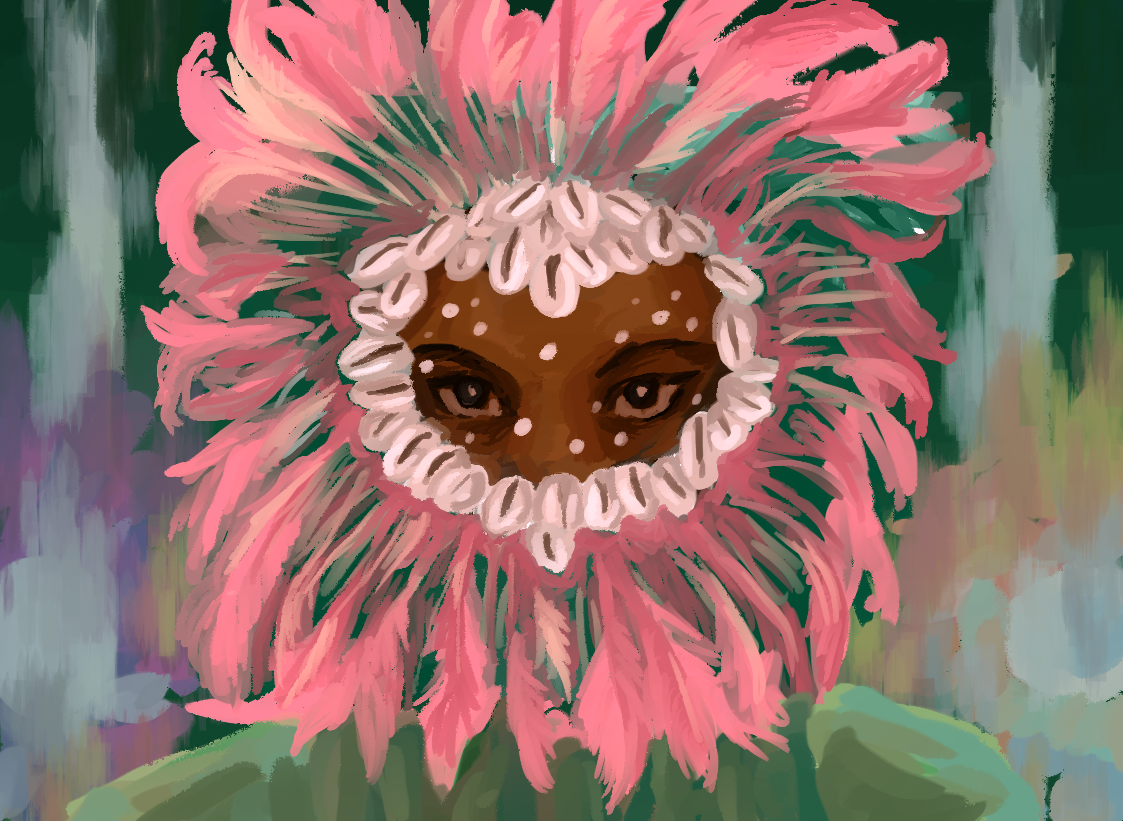
Yelaine Rodriguez, an Afro-Dominican artist, kicked off the 2026 Mexico, the Americas, and Spain (MAS) Álvarez Seminar Series: “Religion in Art as Archive.” On Feb. 5 at 5:30 p.m. in Dicke Hall, the New York-based creator hosted a screening of four of her short films, along with a mini art exhibition entitled “Reclaiming Sacred Histories.”
Elaine Penagos, assistant professor of Africana religions and culture at Trinity, organized this year’s Álvarez Seminar. Penagos said she was inspired by her own research on art as a form of documentation of diasporic religions produced by the transatlantic slave trade. As such, she decided to invite Rodriguez, a multidisciplinary artist and scholar whose work centers on Afro-Syncretic religions.
“The concept of Afro-syncratic, I think in the way that Yelaine uses it specifically, is meant to address more,” Penagos said. “There’s a sort of reclamation project in this work that she’s doing that embraces it [syncretism] as a sort of mechanism for something more than just survival.”
Sarah Reese, senior anthropology major, said one of her takeaways from Penagos’s “African Religions in the Caribbean” was that the religions of that region have been misrepresented historically. To Reese, syncretism often contributes to the falsification of culture, which Rodriguez resists through her visualization of religious practice and ritual.
“For my project last semester, we did art based on what we had learned, and looked into art that represents Vodou, which is such a common religion, but even more so commonly misrepresented,” Sarah said. “There is an importance to how these deities are being represented.”
Rodriguez said slavery in the Americas is crucial context for her academic and visual work, in which she embraces religious syncretism to resist oppression. Rodriguez aims for her work to raise awareness and answer questions surrounding her Afro-Caribbean cultural background.
“My work is about uprooting these narratives about slavery that are constantly being hidden on the island [in the Dominican Republic and Haiti],” Rodriguez said. “My intention with my art is to take these narratives that are hidden, that are purposefully obscured … and screen them on the island.”
Two of the films, “Mal de Ojo” and “Babalu-Aye y La Negra del Hospital,” feature a colorful series of stories about historical places, such as the Door of No Return, and Black women, especially healers like Babalu-Aye. To Rodriguez, these works start an important conversation rooted in the real-life experience of Haitian and Dominican people.
“My work is about stripping the negative stigma about Black people,” Rodriguez said. “I am interested in the beauty and the resistance and the solidarity.”
The event’s second film, “Èzili Dantò, Freedom and the African Diaspora,” centers on Èzili Dantò, a “Ioa” in Haitian Vodou. The concept of Ioas, similar to a Catholic patron saint, merges African religions and Catholicism through distinct colors, names and objects.
“They [Vodou practitioners] have managed to find ways to survive,” Penagos said. “Not by isolating themselves from the world into which they were thrust, but by embracing that world.”
“Miss Doc” explores similar themes. The film tells the story of Sarah Loguen Fraser, the first female doctor in the Dominican Republic. Dancers symbolize “Portals” and create a colorful vision of individual Ioas as a symbol of worship connected to Fraser and her vital work. These Portals are utilized to channel Fraser’s spirit through various sites, such as her home and sites where she worked as a doctor.
Rodriguez is currently pursuing a Ph.D. in Performance Studies at Northwestern University. Through her studies, where she adopts the approach of “critical fabulation,” Rodriguez hopes to enhance her understanding of the body, with an emphasis on how generational history connects to biological concepts.
“I’m so interested in how the body restores knowledge from family,” Rodriguez said. “It can also restore trauma when you least expect it.”
The second part of the Álvarez Seminar, on Feb. 19, will feature a workshop with photographer and visual artist Gabriel Garcia Roman. Like Rodriguez, Roman is a multidisciplinary artist, and the event will center on his process-based art depicting queer icons.
The Student News Site of Trinity University
Your email address will not be published.
Reclaiming cultural histories through ‘Religion in Art as Archive’ – Trinitonian