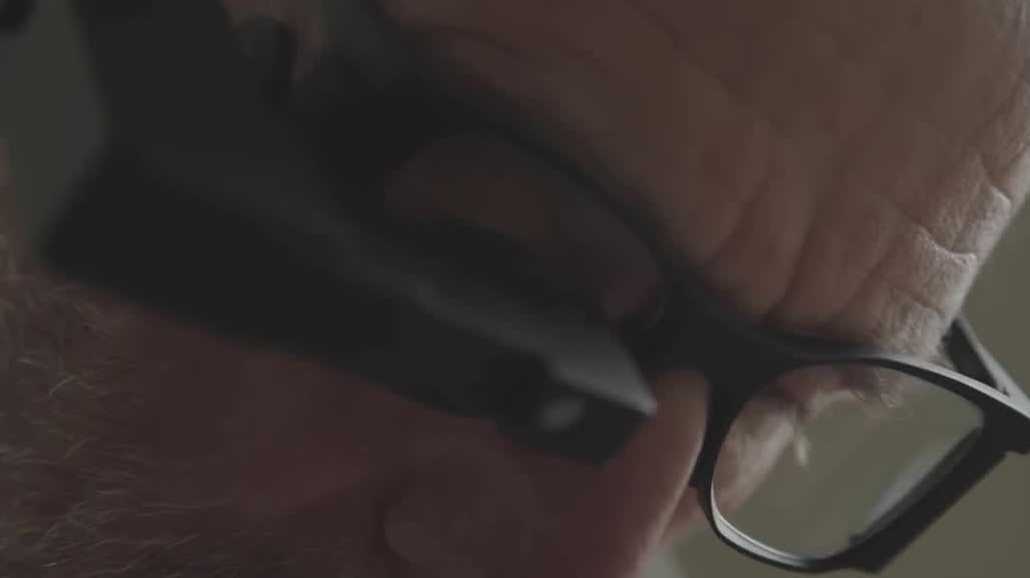
A device called PRIMA is an eye prosthesis that has been developed to help patients with advanced, age-related degenerative eye diseases.
Paired with external glasses, a tiny chip that is surgically placed under the retina is helping people who are legally blind see again.
Surgeons place the device in the area of the retina where light-sensitive cells have been lost to disease, with the chip replacing the function of these cells. It operates similarly to a solar panel, capturing light and transforming it into an electrical signal.
“The patients are wearing goggles or spectacles that have a camera,” said Dr. Jose Alan Sahel, chairman of the Department of Ophthalmology at the University of Pittsburgh School of Medicine and UPMC. “The camera is capturing the light and the signal, the image, then the processing is occurring, and then there is a projector on the goggles that is in front of the chip and is sending the light onto the chip. The chip has 400 electrodes, each independent, and each electrode is able to capture the light and also to amplify the signal to get enough electricity to really trigger the response.”
Sahel has been involved in developing this cutting-edge technology for over 15 years and serves as a senior author of the study.
Initial studies began five years ago with a small group of patients in Paris and Pittsburgh, yielding promising results. The tests were expanded across Europe, culminating in the most recent and largest study, with results released at the end of last year.
“No patient got worse than before, which is very important, of course, and 26 patients in the study had a significant improvement of vision,” Sahel said.
One trial participant, Sheila Irvine, began losing her vision to macular degeneration at around 30 years old.
“When I was driving, I kept hitting the pavement first of all, and then it just stayed steady, and all of a sudden, it rapidly came on,” Irvine said. “My worst day was, I sent my driving license back and I cried all day long.”
An avid bookworm before losing her vision, Irvine said she wanted a chance to read again and was grateful to participate in the trial.
A significant step in retinal prosthetics, the PRIMA chip is tiny — only two millimeters by two millimeters, about the size of a pinhead, and 30 microns thick, half the thickness of a human hair.
Candidates for the technology undergo a roughly two-hour surgery under general anesthesia performed by highly experienced surgeons, allowing patients to leave the hospital the same day. Healing occurs over the following weeks, after which the implant is activated.
Sahel emphasized the importance of the training process that follows.
“People are trained on how to use the information, because it’s not the vision they were used to have before they lost the vision, so there’s a lot of training.”
“I couldn’t see it at all. It was like getting a cloud down and putting it on the page. It was just white,” Irvine said. “One day, I started to see the edge of something, and I thought, ‘Here we go now.’
“It was quite amazing because it’s all new to me. It’s a new way of looking through your eyes.”
Regarding the external technology, the glasses, Sahel noted the potential for individualized adjustments and tweaks, such as changing contrast, using augmented reality and zoom features. The software can also be updated without additional surgery.
When asked if this is a positive step toward restoring vision for those with irreversible blindness, Sahel said, “It’s an important step. But of course, there is much more to do. The implant is being refined currently to improve the resolution. The goggles are being improved. As I mentioned, we work on some of the next generation of optogenetics. We also work on the gene therapy. So it’s not going to be one thing that cures everything.
“We have actually, a project on eye transplantation that we are doing currently, so there are multiple ways to tackle that, stimulating the brain directly in the blind. So, for us, it’s fighting blindness by any possible resource. Any success is giving us the energy to do more and to develop more technologies.”
Sahel said there are ongoing discussions with the U.S. Food and Drug Administration to allow a limited number of patients per year to receive this technology until it gains wider approval.
Hearst Television participates in various affiliate marketing programs, which means we may get paid commissions on editorially chosen products purchased through our links to retailer sites.
New technology helping to restore vision – WTAE