University of Notre Dame
Church Life Journal
A Journal of the McGrath Institute for Church Life
Since roughly 9/11, “religion” has become a white-hot topic in the world of culture, ideas, and journalism. One sees this in books, articles, and blogs; in the burgeoning of “post-secular studies” in the academy; and in a veritable industry promoting “interreligious dialogue.” In the mix, fresh and sometimes compelling attention has been paid to the relationship between religion and violence. A new journal, the Journal of Religion and Violence, aims to study the topic in-depth. Weighty new tomes such as the Blackwell Companion to Religion and Violence and the Oxford Handbook of Religion and Violence reflect the trend, as do numerous conferences and symposia held on the topic.
One should welcome these developments as they engage matters often shortchanged in the past. Still, one wonders if the complex realities under consideration are adequately captured by recourse to the frequently deployed phrase “religious violence.” One need not look hard, moreover, to discover that the recent interest frequently stems from the questionable Enlightenment-derived commonplace that religion is inherently irrational and violent and must always be countermanded by political secularism.
Popular books, such as Hector Avalos’s Fighting Words: The Origins of Religious Violence, reinforce the commonplace: “religion is inherently prone to violence.” Margaret Atwood’s Handmaid’s Tale and its popular television adaptation fantasizes about what a theocracy might look like if troglodyte religionists finally got their way. Not least, the United Nations General Assembly in 2019 established August 22 as “the international day commemorating the victims of acts of violence based on religion or belief.”
In short, for many people, the idea that religion promotes violence and that secularism ameliorates the problem is a settled certainty, an unstated premise of right thinking. “[Assuming] that religion has a tendency to cause violence is part of the conventional wisdom of Western societies, and it underlies many of our institutions and policies,” observes the theologian William Cavanaugh. “The idea that secularism is the best response to religious violence is part of the progress narrative that organizes modernity,” adds the social scientist Janet R. Jakobsen.
By no means do I deny that religious energies—particularly when tied to ethnic identities and material scarcity—can be turned toward destructive ends, especially by unscrupulous politicians in times of crisis. Think of Northern Ireland, the Balkans, Kashmir, or the Middle East. The list is sadly familiar, although Jonathan Swift might have said more than he realized when he quipped that often “we have just enough religion to make us hate, but not enough to make us love one another.”
Nonetheless, concentration on or simply assuming religion’s inclination toward violence insouciantly glides past a glaring reality of the twentieth century: namely, that regimes committed to secularism have not infrequently possessed just as much, and often much more, capacity for violence than those tied to religious identity. Twentieth-century secularist ideologies bear as an ignominious hallmark, moreover, systematic attacks against religious communities. In terms of sheer numbers, the misery, deaths, and destruction visited on religious communities by secularist regimes in the twentieth century vastly exceeds the violence committed during the early-modern European Wars of Religion, which are routinely invoked to legitimize the necessity of the modern secular nation-state.
To be sure, not all forms of secularism tend toward violence. Distinctions are necessary. But at least two kinds have, and it is worth pondering why. To do so, one must return to the ideological ferment of the nineteenth century. In the wake of the French Revolution and Napoleonic Wars (1789–1815), debates about the appropriate relationship between religion and government in a modern polity became pointed and acrimonious across Europe and in the Americas. Confronted by a partially restored Ancien Régime after 1815 eager to return to the throne and altar model in medieval fashion, proponents of modernity theorized three principal ways to resolve the religio-political dilemma of their age—what we might think of as passive secularism, combative secularism, and eliminationist secularism. In the twentieth century, borne by the influence of Western ideas and institutions, these solutions went global.
While citizens of the United States might not recognize a term like passive secularism, they know from experience the political-religious arrangements it describes, for, broadly speaking, this is the solution offered by the U.S. Constitution’s First Amendment (1791): the national government should neither establish a religion nor meddle with citizens’ free exercise of their faith. Briefly, before the French Revolution’s radical turn, something comparable held sway in France, and the Belgian Constitution of 1831 exemplifies it in spades. In the nineteenth century, liberal thinkers such as Benjamin Constant, Alexis de Tocqueville, and Lord Acton endorsed versions of passive secularism and its more familiar cognates: freedom of conscience or freedom of religion. The roots of passive secularism would return one to figures such as John Locke, especially his Letter Concerning Toleration (1689), written as a pragmatic solution to the religio-political turpitude that convulsed Britain in the seventeenth century. But it arguably possesses much deeper roots in early Christian thought, as the church historian Robert Wilken perceptively argues in his book, Liberty in the Things of God: The Christian Origins of Religious Freedom (2019). In the twentieth century, the UN’s Universal Declaration on Human Rights (1948) and Vatican II’s Dignitatis humanae or Declaration on Religious Freedom (1965) are instances of passive secularism. While realities do not always live up to ideals, this form of secularism, when adopted in actual states, has been decidedly less a concern for violence than the other two. Too often, though, Westerners assume this is the only form of modern secularism when in fact this is patently not the case, particularly when one adopts a broader historical and global outlook.
Combative secularism, more problematically, descends from the radical stages of the French Revolution after 1792. At this time, the anticlerical sentiment of the French Enlightenment typified in the philosophe Voltaire’s pet phrase écrasez l’infâme—crush the loathsome thing, i.e., the Catholic Church—gained an outlet for political expression. This resulted in extensive measures of de-Christianization: the shuttering and destruction of churches and monasteries, erasure of the Christian calendar, rampant iconoclasm, guillotining of many clergy, and a genocidal response to Catholic opposition to revolutionary excesses in the Vendée region of Western France. Often if not always tempering its early capacity for violence, this form of secularism—tagged later as laïcité (secularism, laicism)—grew apace throughout the nineteenth century, coming to expression in the European-wide revolutions of 1830 and 1848, and it found a congenial political home in the anticlerical polices of the French Third Republic (1871-1940).
In the late nineteenth century, this version of secularism derived major intellectual support from the positivist August Comte’s theory of stadial civilizational development, which posited theological and then philosophical stages of human history inexorably giving way to a purely “positivist” one—an age of science and strictly immanent conceptions of well-being. The Third-Republic politician Léon Gambetta exemplified combative secularism, sloganeering le cléricalisme, voilà l’ennemi! (clericalism, that’s the enemy!) throughout much of his career. For Gambetta and other committed anticlericals (within and beyond France), the church assumed the role of a “mythic enemy,” the antithesis of Revolution, reason, and progress, according to the scholar Joseph Moody: “the function of the myth . . . simplified beliefs [and] gave a single satisfactory object to passions that otherwise would be tempered by contradictory data.” Such assertive laïcité informed the French Law of the Separation of Church and State (1905), which fractured French society and effectively crushed the Catholic Church’s role in public life. The outcome in France invited imitation from other republican-anticlerical polities. In the twentieth century, revolutionary Mexico, republican Spain, and post-Ottoman Turkey embraced and adapted versions of combative secularism, ratcheting up its anticlerical hostility and capacity for violence.
Finally, eliminationist secularism was a solution shaped by Europe’s Far Left—by Ludwig Feuerbach, Karl Marx, Friedrich Engels, Pierre Proudhon, and Mikhail Bakunin, among others. “The first duty of a free and intelligent mind,” Proudhon wrote, “is to chase the idea of God out of his mind incessantly.” Despite the well-known phrase of religion serving as “the opiate of the masses,” Marx wrote little on religion per se, concentrating on political and economic matters. But its place in his thought is crucial and influential. In brief, Marx felt that religious belief was a species of false consciousness, a compensatory delusion resting on unjust social conditions and a major source of human alienation. Once the proletarian revolution overcame these conditions, religion would simply be eliminated, becoming a curious relic of humanity’s pre-socialist past. Implied in this view, however, are potentially major problems for a Marxist regime. What if religion fails to follow its Marxist script and wither away? This reality confronted many socialist regimes in the twentieth century: the persistence of religion became therefore a major embarrassment, a worrisome sign of the failure of theory, not to mention a rival source of moral judgment and a breeding ground for political dissent. To save appearances, socialist regimes resorted to extensive measures in the Soviet era to repress, persecute, and/or control religious elements in society. What Lenin and Stalin began in the 1920s and 1930s, figures such as China’s Mao Zedong and Albania’s Enver Hoxha, among others, continued during the Cold War.
Despite their differences, both combative secularism and eliminationist secularism descend from the Enlightenment’s progressive wing—what the intellectual historian Jonathan Israel has influentially called the Radical Enlightenment. They stem from the belief that secular reason should everywhere supplant tradition and “superstition” and that an individual or group’s religious convictions ought to take a back seat to collective immanent social progress. Surveying the Communist onslaught against religious communities in the twentieth century inclines one to understand not only Voltaire’s écrasez l’infâme but also the philosophe Diderot’s well-known quip that “men will never be free until the last king is strangled with the entrails of the last priest” not as instances of rhetorical excess, but as prescriptive desiderata. As the philosopher and dissident from Communist Poland Leszek Kolakowski once wrote: “The rationalism, contempt for tradition, and hatred of the mythological layer of culture to which the Enlightenment gave birth developed, under Communism, into the brutal persecution of religion, but also into the principle that human beings are expendable: that individual lives count only as instruments of the ‘greater whole’ or the ‘higher cause,’ i.e., the state, for no rational grounds exist for attributing to them any special, non-instrumental status.” The historical record lends credence to Kolakowski’s judgment.
Finally, both combative secularism and eliminationist secularism have abetted violence not only by what secularist regimes have afflicted on their own populations, but by the forms of zealous backlash that they have often inspired by their intrusive overreach. While rank-and-file believers have often sympathized with the political objectives promoted by modernizing secularist regimes (equality, literacy, redistribution of wealth), they have often found themselves driven into the arms of the regimes’ adversaries by their disagreement over the harsh treatment of the religious sector of society or by the fact that a state-imposed secularism did not accompany genuine democratization and freedom, as was often promised. Zealous (political) secularism, in other words, has ironically sometimes begotten a zealous (religious or religiopolitical) counter-reaction, and thus the former deserves at least an honorable mention in the causal chain leading to the latter.
From its theoretical hatchery in France, combative secularism found fertile soil in other Western countries in the late nineteenth and early twentieth century, often developing in dialectical counterpoint to forces of reaction. In these locations, it merged with local forms of anticlericalism and continued a long history of church-state conflict. But it was in Spain and Mexico that combative secularism (laicismo) reached its fullest extent, tipping into violence.
To be sure, all sides bear moral responsibility for misdeeds committed during the Spanish Civil War (1936–39), but atrocities against the church by republican forces merit spotlighting, for too often they are elided in discussions of this conflict. With virtual immunity, radical elements indulged in an orgy of violence against “superstition” and “fanaticism,” beginning shortly after the Second Republic was formed in 1931 but spiking during the war years. Thanks to the painstaking research by the Spanish historian Antonio Montero Moreno, the numbers alone tell a story: 6,832 clergymen—including thirteen bishops, 4,172 diocesan priests and seminarians, 2,364 monks and friars, and 283 nuns—were summarily executed and many others persecuted. Forms of killing were often brutal: drowning, hanging, suffocation, shooting, or being buried alive. The corpses were sometimes mutilated and dragged through the streets for further desecration.
Vandalism, arson, and iconoclasm against the Church’s material culture added insult to injury. Beginning in Madrid and Barcelona in July 1936 and then spreading elsewhere, numerous churches were torched—often preceded by a public bonfire that destroyed religious articles inside. Clerical vestments were sometimes used in the staging of mock processions, and many Catholic monuments were toppled. In his Homage to Catalonia (1938), George Orwell recounts how rabid anticlericals painstakingly chiseled out every cross in a local cemetery. Following from the script of the French Revolution, moreover, streets, villages, and parks named after saints were ritualistically renamed.
In the fever of war, as the historian Julio de la Cueva has argued, the church emerged as a “perfect scapegoat,” a visible sign of the past that had to be eradicated if the republicans wanted “a new, better, and unpolluted society.” The terror of this time “was the most extensive and violent persecution of Catholicism in Western history, in some way even more intense than that of the French Revolution,” adds the historian Stanley Payne. Perhaps one anticlerical militant during the Civil War captured the situation best when—speaking to a woman pleading that her parish priest’s life be sparred—he responded: “There is no other god than us.”
Spain’s erstwhile colonial daughter, Mexico, witnessed its own share of secularist violence. Against a backdrop of church-state conflicts across Latin America in the nineteenth century, events in Mexico in the early twentieth century allowed for extensive desfanatización, as anticlericals called it. The trouble started after the Mexican Revolution of 1910. The new Constitution, enacted in 1917, bristled in hostility toward the church and religion; it outlawed religious education, put church property at the disposal of the state, banned religious orders and foreign-born priests, and gave to the federal states almost unlimited powers to curtail or get rid of priests in their territories. Mexican revolutionaries, in the words of the historian John Lynch, were “determined to destroy the Church and obliterate religion . . . in the interests of state power and national progress.”
Stepped-up enforcement of the Constitution’s anticlerical measures under President Plutarco Elías Calles led to the so-called Cristero War (1926–29) between rural Catholic rebels and the anticlerical federal government—a conflict with striking echoes of the Vendée revolt in France in the 1790s. Claiming some 90,000 lives on both sides, the war witnessed the government expropriating churches for its own purposes, deporting and imprisoning priests and bishops, and raiding individual parishes. Antireligious violence continued well into the 1930s, after the rebellion had been put down. The effects on the Catholic church were marked. Between 1926 and 1934, at least forty priests were killed, and others were eliminated by emigration or expulsion. The wanton murder of the Jesuit Miguel Pro is perhaps the best known case. The country of 15 million Catholics had 4,500 official priests before the Mexican Revolution; afterwards, just 334. By 1935, seventeen states (out of thirty-two) had no publicly recognized priest at all.
The Mexican state of Tabasco witnessed the worst persecution under Governor Thomas Garrido Canabel, whose merciless anticlerical rule served as inspiration for Graham Greene’s The Power and the Glory (1940). In the novel, the character of “the lieutenant,” roughly based on Canabel, becomes infuriated every time he thinks “[that] there were still people in the state who believed in a loving and merciful God.”
The legacy of combative secularism also necessitates consideration of the Anatolian peninsula and the birth of Turkey as a modern nation-state—a remarkable example of the transfusion of Western thought eastward and a major turning point in world history.
Rising to power in the aftermath of World War I, Mustafa Kemal presided over the collapse of the Ottoman Empire and the creation of modern Turkey. From 1923 until his death in 1938, Kemal, who took the name Atatürk (Father of the Turks) in the 1930s, implemented one of the most coercive, top-down secularization processes in human history, copying directly from the playbook of France’s Third Republic, even adapting the French term laïcité (laiklik), because the Turkish language lacked a word for the concept. During the early years of the Republic, Kemal’s regime abolished the office of Caliphate—the historic protector of all Muslims that had existed for thirteen centuries and went back to the Prophet Muhammad—and established the Diyanet or Directorate of Religious Affairs to regulate and surveille religious bodies in the country. Further reforms sought to cripple the legacy of Islam, which Atatürk privately loathed as a “putrefied corpse.” Traditional religious dress such as the fez and turban were forbidden, the Islamic calendar was replaced with the Western one, the teaching of Arabic was banned, extremist Turkish nationalism was promoted (at the lethal expense of Greek, Armenian, and Kurdish minorities), religious schools (madrases) were forcibly closed, and the term laiklik inserted directly into the Turkish Constitution. In 1924 and 1925, Kemalist reforms forcibly closed popular Sufi lodges, worried that they encouraged political dissent. In the late 1920s and 1930s, Atatürk’s regime established special tribunals to eliminate outspoken opponents, arresting thousands and executing hundreds in a process described by one historian as “measured terror.” In 1933, adherence to “Kemalism” became mandatory in all educational institutions—a measure that led to the dismissal of two-thirds of the faculty at the University of Istanbul on charges of disloyalty. Over time, the judiciary and military, not the people, became the authoritarian organs supporting the regime. Harsh sentences were meted out for even minor offenses, such as wearing inappropriate headwear.
Kemalist secularism became the standard-bearer for the emergence of other secularist and nationalist regimes throughout the Middle East, such as those in Egypt, Tunisia, Algeria, Syria, and Iraq. In running roughshod over traditional religious beliefs and institutions, these regimes have played a role in stoking the flames of Islamic extremism. “Their wide repression,” notes the political scientist Daniel Philpott, “has contributed to a fierce backlash by convincing Islamists that only through the gun can they influence politics.” For serious Muslims with a commitment to practice their faith, Kemalist secularism has been difficult to accept. It was frequently joined at the hip with humiliating bans and harassment of Islamic communities and their traditions. Overthrowing the secular order and installing in its place Islamist regimes, therefore, became a determined goal among a rising generation of Islamists—and arguably an ironic legacy of Turkish laiklik.
Repression and persecution by republican anticlerical regimes in the twentieth century, characterized by combative secularism, were severe. However, these actions were far less extreme than those carried out under Marxist-Leninist and Maoist regimes. The latter followed an eliminationist form of secularism that sought at certain historical junctures to completely eradicate religion.
After the Bolshevik Revolution of 1917, the nascent Soviet Union became the first country in world history philosophically committed to materialist atheism. It saw the Orthodox Church as a defiant remnant of the old order, and acted quickly to take away its right to hold property and eliminate its involvement in educational and welfare facilities. Intermittent violence, imprisonment, and repressions followed, becoming more systematic in 1922. Faced with famine conditions at this time, Lenin, who regarded all religion a “spiritual booze,” developed the ruse that the church should hand over its valuables for famine relief. If the clergy refused, Lenin demanded in a letter to the Politburo that state officials “carry out the seizure of church valuables with the wildest and most merciless energy.” In the same letter, he called for a “ruthless battle” against the church, declaring that “the greater number of representatives of the reactionary clergy . . . we manage to shoot on this basis, the better.” Actions followed words.
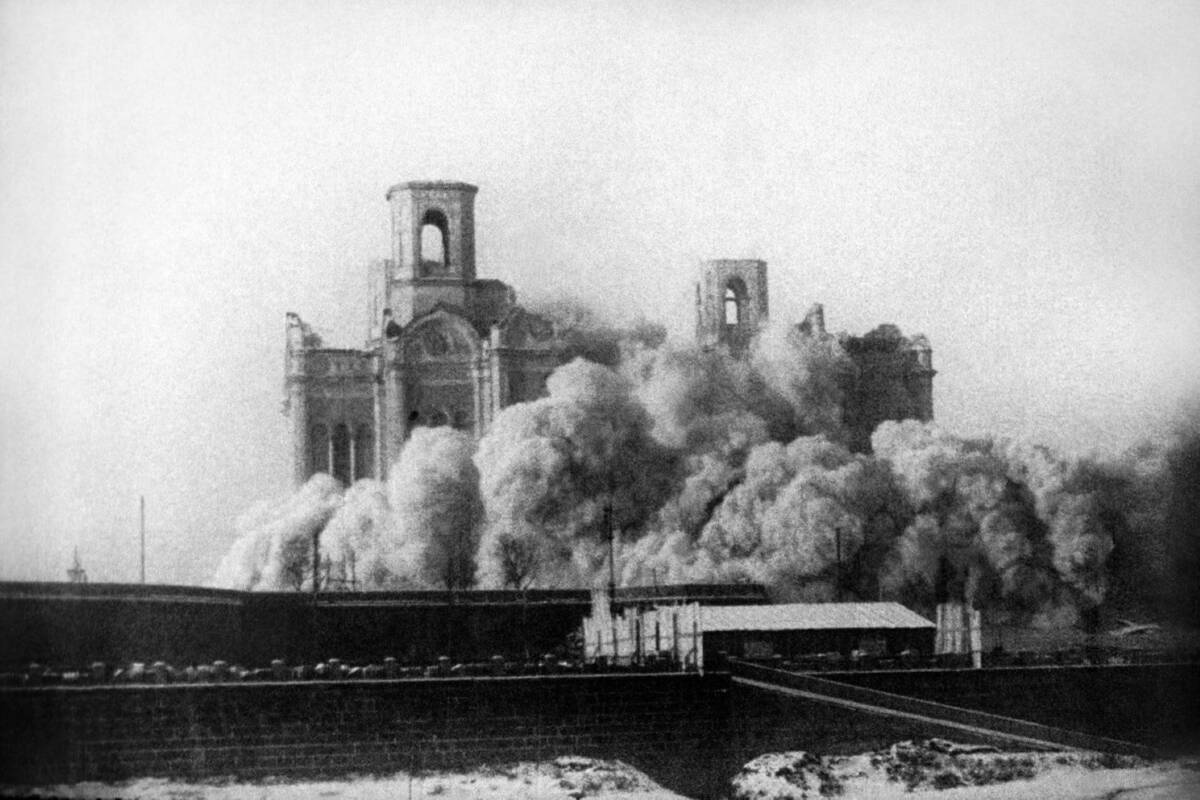
In the power struggle after Lenin’s death in 1924, the Orthodox church, consumed with its own internal divisions, experienced some respite. But that changed dramatically after Stalin came to power in 1928 and sought to devastate religion in a headlong rush to create a higher form of humanity: homo sovieticus. New legislation in 1929 paved the way for harsh antireligious measures that lasted until World War II. The quasi-official organization the League of the Militant Godless received warm support from Stalin and actively promoted the elimination of religion through propaganda, publications, and re-education campaigns. Antireligious education began in the first grade; churches were prevented from publishing and some were turned into “museums of atheism,” presenting religious belief in the worst possible lights; many vocal clergy and laypeople simply disappeared. What is more, numerous churches were shuttered or destroyed—most infamously perhaps Moscow’s Cathedral of Christ the Savior, dynamited on December 5, 1931, eventually replaced with a brutalist-style public swimming pool.
The Great Terror or Purge years of 1937 and 1938 with its show trials were especially brutal for the devout. Historical records indicate that tens of thousands of clergymen were arrested during these years and many executed. Many others died in the gulags. By 1939 the church had virtually ceased to exist. Of the approximately 50,000 churches that existed prior to the Revolution, only several hundred functioned in 1940. A similar devastation befell Orthodox monasteries, several of which were turned into prisons. Stalin relaxed religious persecution during World War II in order to shore up nationalist support, but such persecution was taken up again, and in a major way, by Nikita Khrushchev in the 1950s and 1960s. “Next to economic hardships,” as the historian Richard Pipes has summarized the Soviet anti-religious fury, “no action . . . [of the Soviet State] inflicted greater suffering on the population at large than the profanation of its religious beliefs, the closing of houses of worship, and the mistreatment of clergy.”
Soviet-era brutalities did not only affect the Orthodox church. Catholics, both Latin and Eastern rite, and smaller Christian denominations faced hostilities too, as did observant Jews. Shabbat was abolished in 1929, along with other religious holidays. In Soviet-dominated Mongolia, moreover, the Stalinist stooge Khorloogiin Choibalsan implemented in 1937–39 the so-called Great Repression, a ghastly parade of show trials, sentences, and executions in which thousands of Buddhist lamas and monks perished and virtually every Buddhist monastery in the country was desecrated and destroyed. Something similar happened to the Buddhist minority inside the Soviet Union. A comparable assault against Islam took place in Soviet-controlled Central Asia, where an estimated 26,000 mosques prior to World War I were reduced to 1,000 by 1941. Books in Arabic were banned; Muslim schools and charities (waqfs) were shut down; vocal imams were silenced, and women were forced to unveil themselves. “In the history of Central Asia,” the historian Adeep Khalid has written, “the fury of the [Soviet] regime’s attack on Islam and its institutions is comparable perhaps only to that of Genghis Khan.” These actions, combined with the Soviet military’s decade-long dalliance in Afghanistan in the 1980s, conscripting Muslims to fight against fellows Muslims, played no small role in incubating a generation of radical Islamists, and in turn helping set in motion the chain of circumstances necessary if not alone sufficient to explain the ordeal of 9/11.
Other Marxist-Leninist states took their cues from the Soviet Union, including North Korea, the Soviet-bloc countries of Eastern Europe, and Cuba after 1959. As in the USSR, these governments officially embraced materialist atheism and clashed with religious institutions that refused to vanish, defying the predictions of Marxist theory. The intensity of repression varied across countries. At a minimum, churches were heavily monitored and subjected to burdensome regulations; at worst, they experienced persecutions that rivaled or even exceeded those in the Soviet Union. As Kolakowski observed, “once the state had become the appanage of the party with its anti-religious philosophy, separation [of church and state] was impossible. The party’s ideology became that of the state, and all forms of religious life perforce became anti-state activity.”
This was acutely true in Albania, where the dictator Enver Hoxha practically made Stalin look moderate. Hoxha’s ascent to power in the mid-1940s resulted in the state’s stepped-up regulation of all three faiths in the country (Orthodoxy, Catholicism, Islam), the nationalization of religious properties, and the imprisonment, expulsion, or execution of religious leaders—often preceded by show trials. On November 22, 1967, in Decree 4377, Hoxha went a step further, simply declaring religion, in any form, eradicated and henceforth illegal. The measure coincided with a sweeping attack on religious institutions. Priests, bishops, and imams were imprisoned, publicly humiliated, or killed. Nearly all of 2,169 churches, monasteries, and mosques in this small country were vandalized, destroyed, or turned into dance halls, basketball courts, theatres, and the like. As one father remembered the time: “Parents were afraid to teach their children explicit words such as ‘love God and neighbor’ because a child might unwittingly use them in school,” triggering the government’s retaliation. Places and streets named after religious figures were changed. One could not even name a child after a biblical or Qur’anic figure but had to choose from the government’s list of acceptable names. “What happened in Albania has never happened before in history,” Pope John Paul II told a crowd in a visit to the country after Communism had collapsed, because here “the state tried to destroy all religious expression in the name of radical atheism.”
The pope’s sentiment was certainly sincere, but one might quibble with the facts, because Mao Zedong attempted something similar in South Asia—and his far-flung legacy, “Maoism,” proved to be a scourge to religious communities around the globe during the twentieth century.
After the Communist victory in 1949, the People’s Republic of China lurched in a secularist direction, combining Marxist-Leninist ideas about society with those of previous Republican-era Chinese modernizers operating under the mantra of “smash temples, build schools.” “Religion is poison . . . inimical to material progress,” Mao told the young Dalai Lama in the 1950s. With the Great Proletarian Cultural Revolution (1966–76), religious persecution kicked into high gear. In a frenzy of revolutionary fervor, Mao convinced idealistic young people (“Red Guards”) to attack the “four olds”: old customs, old habits, old beliefs, and old ideas. En masse, churches, shrines, and temples were desecrated and destroyed. Clergy, monks, and other religious leaders regularly became targets of “struggle sessions” by the Red Guards, who harassed and humiliated them, often leading to death or suicide. All major faith traditions in China—Confucian, Daoist, Buddhist, and Christian—experienced crippling setbacks during these years—and this is to say nothing of China’s Uighur Muslim minority and smaller salvationist sects that have faced continual harassment since the founding of the Republic until the present.
Invaded by China and cruelly occupied since 1950, Tibet and its rich Buddhist traditions were plunged into the deepest abyss during the Cultural Revolution. Irreplaceable manuscripts, symbols, and statues were destroyed or repurposed. Sayings of Mao were carved onto mountainsides over Buddhist prayers, the ubiquitous prayer flags forbidden to fly. By the end of the Cultural Revolution more than 6,000 Tibetan monasteries had been laid waste; only twelve were left standing. Tibetan Buddhist monks and nuns, numbering hundreds of thousands in 1950, were subjected to physical and psychological torture and almost completely wiped out by the late 1970s—with the center of Tibetan Buddhism moving to the Dalai Lama’s exilic location in Dharamsala, India, first granted by the Indian government in 1959 as a place for refugees fleeing Mao’s forces.
Whether in Tibet or China, most lay believers ceased public and even private displays of faith during the Revolution out of fear. Credible estimates of all deaths during the Cultural Revolution range as high as a two million. These bitter years, 1966-1976, witnessed, in the words of the historians of Chinese religion Vincent Goossaert and David A. Palmer, “the most thorough destruction of all forms of religious life in China and, perhaps, human history.”
As the Revolution raged in China, Cambodia’s Pol Pot took notice, having already fashioned his own brand of Marxist-Leninist ideology during an extended study sojourn in France. When the Khmer Rouge finally slithered into power in 1975, the new regime sought to obliterate Cambodia’s history and start from “Year Zero,” with the intention of eradicating all forms of traditional culture and religion. The Catholic Cathedral in Phnom Penh was dismantled brick by brick. The venerable tradition of Theravada Buddhism became a primary target for elimination. Pagodas were turned into prisons, monasteries despoiled, sacred objects and texts reduced to ashes. Monks were disrobed and forced into marriage or military service. In the 1960s, prior to the Khmer Rouge seizing power, Buddhist monks and novices—regularly referred to as leeches and parasites by the regime—numbered around 65,000. When the Khmer Rouge fell from power in 1979, fewer than several hundred monks remained in the entire country. Most had sought refuge in neighboring states or were killed, joining the ranks of the approximately twenty percent of all Cambodians who perished under Pol Pot. “For centuries, the Buddhist wat or temple was the center of village life, the source of learning, the reservoir and transmitter of Cambodian culture,” but then, as the scholar Karl D. Jackson has summed up, “[the] Khmer Rouge policy toward Buddhism constituted one of the most brutal and thoroughgoing attacks on religion in modern history.” Tragically, Cambodia’s 500,000 Cham Muslim minority, often cruelly forced to raise pigs and eat pork against their dietary rules, fared even worse.
In treating state-sponsored violence of the twentieth century, historians usually focus on anti-Semitism and other forms of racism (Hitler and his puppets) and class warfare (Lenin, Stalin, Mao)—as well as nationalism and age-old raisons d’état—as the principal culprits. I do not wish to downplay these factors. At the same time, placing a spotlight on secularism—or what I have identified as its combative and eliminationist varieties—affords analytic insight as well, at least in a minor key even as it needs to be tempered with several caveats and qualifications.
By way of caveat, secularism of course does not exhaustively explain the examples of violence given here. History is messy and other factors come into play as well. In addition to Maoist antireligious animus, for example, China possessed a long-standing historical interest in subduing Tibet politically. Thus, secularist goals often came alloyed with other motivations—and sometimes they even cloaked these motivations in the panache of (Western-imported) ideological sophistication, appealing to stadial conceptions of history and putatively inexorable laws of the progress.
Sometimes, too, secularist regimes obtained feckless and/or intimidated religious supporters. The Metropolitan of Moscow Sergius’s ignominious declaration of loyalty to the Soviet Union in 1927 stands out as a prime example of this. Other secularist regimes, too, found willing collaborationists among the religious—often willing to accept bribes and perks in exchange for docility.
In addition, victims of secularist violence were certainly not always innocent lambs, but often committed misdeeds as well. Franco’s nationalists in the Spanish Civil War, for example, gave as good as they got, as did the Cristero rebels in Mexico—to offer just two examples. Not every priest, rabbi, lama, or imam confronted with hostility responded with charitable intent or diplomatic prudence—and no doubt some of the religious traditions and practices that they sought to defend would likely not go down well with many Westerners today.
The two types of secularism profiled here, moreover, should not be conflated. For the most part, combative secularism—more anticlerical than antireligious in orientation—did not launch a scorched-earth attack against all forms of religious commitment (and was even welcomed by some religious minorities). Eliminationist secularism sometimes did—or at least it more readily had that potential, tethered, as it was, to Marxist-Leninist ideology that saw the decline of faith as a bellwether of success and its resilience—and the politicization of this resilience—as a serious problem. Furthermore, combative secularism—notably, say, in Turkey—often found itself joined at the hip with nationalist projects, while its Marxist-Leninist counterparts espoused internationalist visions—at least in rhetoric after 1917 if not always in practice later on.
At the same time, combative and eliminationist secularism share some things in common. They both might be described as species of exclusive humanism, a term employed by Charles Taylor and Henri de Lubac in their studies of modernity, in their commitment to immanent, stadial schemes of human progress. Relatedly, both evinced confidence in the capacity to bend history toward emancipatory ends and a trust in the state’s technocratic ability and security apparatuses to manage and punish dissenters. In this sense, they corroborate James C. Scott’s insight in his wide-ranging Seeing Like a State: How Certain Schemes to Improve the Human Condition Have Failed (1998) that confident, schematic, centrally orchestrated visions of human improvement regularly overstep or go awry because they do violence (literally in these cases) to the practical wisdom and particular allegiances embedded in local communities and civil society, including in religious traditions. Both types of secularism, moreover, often displayed precious little capacity to embrace Alexander Solzhenitsyn’s adage that the line dividing good and evil runs through every human heart, not between groups of people.
The story of violence-prone secularity, alas, is not over. In some Western democracies, softer forms of combative secularism have steadily eroded more humane models of passive secularism—especially in matters of religious dress and practices such as circumcision. In China, Neo-Maoism has made a powerful return under Xi Jinping, whose policies target not only Uyghur Muslims but also unregistered Christians and other faith traditions, even if these rarely attract Western media attention. Tibetan Buddhism, meanwhile, faces the slow suffocation of its institutions and culture at the hands of the Chinese Communist Party. Then there are the curious holdover Marxist-Leninist regimes—North Korea, Vietnam, and Cuba—where religious communities have long suffered, often in silence, under repressive rule. All this is to say nothing of the diverse forms of religio-political extremism that have emerged, at least in part, as reactions to past secularist overreach.
In sum, violence growing out of these strands of secularism should chasten those post-9/11 critics convinced that “religion” is but a stepping-stone to violence, even as it complicates simplistic narratives of modernity as a passage from (violent) religious obscurantism to (peaceable) modern enlightenment. Religious traditions have been complicit in violence, to be sure. The historical record on this is clear and invites further inquiry. Even so, the fact that secularism, too—and on a massive scale—has both fostered and served violent ends should make us think twice about the reliability of our assumptions and vocabulary in thinking perspicaciously about these complex matters. Which secularism, whose religion, under what circumstances, and with what other factors, we might more probingly ask? In the final analysis, anyone inclined to invoke “modern secularism” indiscriminately as an antidote to religious violence might speak eloquently but not accurately, handicapped by potent historical amnesia.
EDITORIAL NOTE: This part of history is covered in greater detail in Broken Altars: Secularist Violence in Modern History (Yale University Press, 2025).
Featured Image: Archival photo of the demolition of Christ the Savior Cathedral in 1931, no known author, presumed Public Domain.
Posted in Theology
Thomas Albert Howard
Thomas Albert Howard is professor of humanities and history and holder of the Phyllis and Richard Duesenberg Chair in Christian Ethics at Valparaiso University. He is the author of many books, including The Faiths of Others: A History of Interreligious Dialogue.
Read more by Thomas Albert Howard
Next Article
|

Copyright © 2025 University of Notre Dame
McGrath Institute for Church Life Church Life Journal Notre Dame, IN 46556 USA
Accessibility Information
A Very Short Introduction to Secularist Violence in Modern History – Church Life Journal