Medical Design and Outsourcing
By Leave a Comment
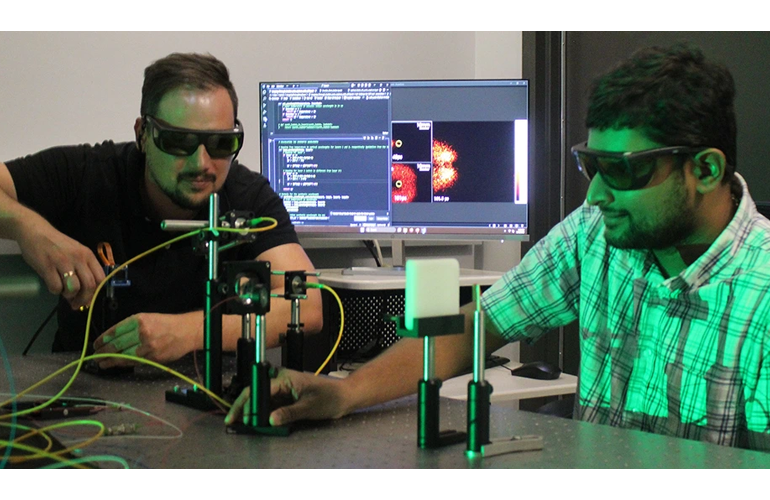
Researchers align their Synthetic Wavelength Imaging lab bench prototype to image non-melanoma skin cancer. [Image courtesy of the University of Arizona]
The project, led by Florian Willomitzer in the James C. Wyant College of Optical Sciences and Dr. Clara Curiel-Lewandrowski in the University of Arizona Comprehensive Cancer Center, is one of only four nationwide projects funded through the NIH’s “Advancing Non-Invasive Optical Imaging Approaches for Biological Systems” initiative. The final award amount will depend on the completion of milestones and the availability of funding.
The group will develop an imaging system based on synthetic wavelength imaging (SWI). The method combines two illumination wavelengths to form a single synthetic wavelength that can penetrate deeper into tissue with less scattering while maintaining high image contrast. The researchers plan to use the technology to improve the visualization of non-melanoma skin cancers such as basal cell carcinoma and squamous cell carcinoma.
“This project specifically focuses on nonmelanoma skin cancers, such as basal cell carcinoma or squamous cell carcinoma,” said Willomitzer, associate professor of optical sciences. “Those skin cancers can display significantly different imaging contrast properties than melanoma, which poses a unique challenge to the development of new ‘deep’ imaging technologies.”
Current optical imaging methods, such as confocal microscopy and optical coherence tomography, provide high resolution but limited depth due to light scattering, while ultrasound and hybrid techniques can image deeper layers but with less contrast.
“From a translational standpoint, this limitation is particularly important,” said Curiel-Lewandrowski, chair of dermatology in the College of Medicine–Tucson and co-director of the Skin Cancer Institute. “Patients with nonmelanoma skin cancers often present with lesions that vary widely in size, depth and pattern of invasion.”
The new approach aims to combine both depth and detail, providing clinicians with a tool to define tumor margins and monitor treatment responses in real-time.
Dr. Clara Curiel-Lewandrowski
“To achieve this, we need tunable imaging capabilities that balance depth penetration with resolution and imaging contrast – something that current technologies cannot reliably provide,” Curiel-Lewandrowski said.
Researchers anticipate that the work will lead to the first clinical demonstration of synthetic wavelength imaging for assessing nonmelanoma skin cancers.
“Our goal is to translate these imaging advances into clinical practice,” said Curiel-Lewandrowski. “If we can detect invasive lesions earlier, define tumor margins more precisely and monitor response to non-invasive treatments in real time, we can maximize the effectiveness of emerging therapeutic approaches. This will also allow us to tailor intervention length and dosing individually to each patient.”
Danielle Kirsh is an award-winning journalist and senior editor for Medical Design & Outsourcing, MassDevice, and Medical Tubing + Extrusion, and the founder of Women in Medtech and lead editor for Big 100. She received her bachelor’s degree in broadcast journalism and mass communication from Norfolk State University and is pursuing her master’s in global strategic communications at the University of Florida. You can connect with her on Twitter and LinkedIn, or email her at dkirsh@wtwhmedia.com.
You must be logged in to post a comment.
Subscribe to Medical Design & Outsourcing. Bookmark, share and interact with the leading medical design engineering magazine today.
DeviceTalks is a conversation among medical technology leaders. It’s events, podcasts, webinars and one-on-one exchanges of ideas & insights.
The Medical Device Business Journal. MassDevice is the leading medical device news business journal telling the stories of the devices that save lives.
Copyright © 2025 WTWH Media, LLC. All Rights Reserved. The material on this site may not be reproduced, distributed, transmitted, cached or otherwise used, except with the prior written permission of WTWH Media LLC. Site Map | Privacy Policy | RSS
University of Arizona researchers win $2.7M NIH award for noninvasive imaging technology – Medical Design & Outsourcing