Updates to our Terms of Use
We are updating our Terms of Use. Please carefully review the updated Terms before proceeding to our website.
Wednesday, April 23, 2025
Republicans and Democrats are feuding over campaign finance rules at the Supreme Court, but the justices have an off-ramp to avoid partisan politics, if they’re willing to take it.
WASHINGTON (CN) — President Donald Trump’s vow not to enforce limits on campaign spending between political parties and candidates threw a wrench into the Republican effort to wipe out the regulation for good next week at the Supreme Court.
The Constitution grants judicial authority over cases and controversies, but the federal government’s abandonment of the cap statute and the fact that none of the plaintiffs qualify to be regulated by it throw the Supreme Court’s jurisdiction into doubt.
“This case raises fundamental questions not just about the First Amendment, but also about the court’s power to declare a federal law unconstitutional in the absence of a real-world controversy,” wrote Roman Martinez, an attorney from Latham & Watkins.
Martinez is a seasoned advocate who the Supreme Court appointed to defend the statute after the federal government refused to do so. Martinez has argued 15 cases before the high court, securing wins in consequential disputes such as Loper Bright v. Raimondo.
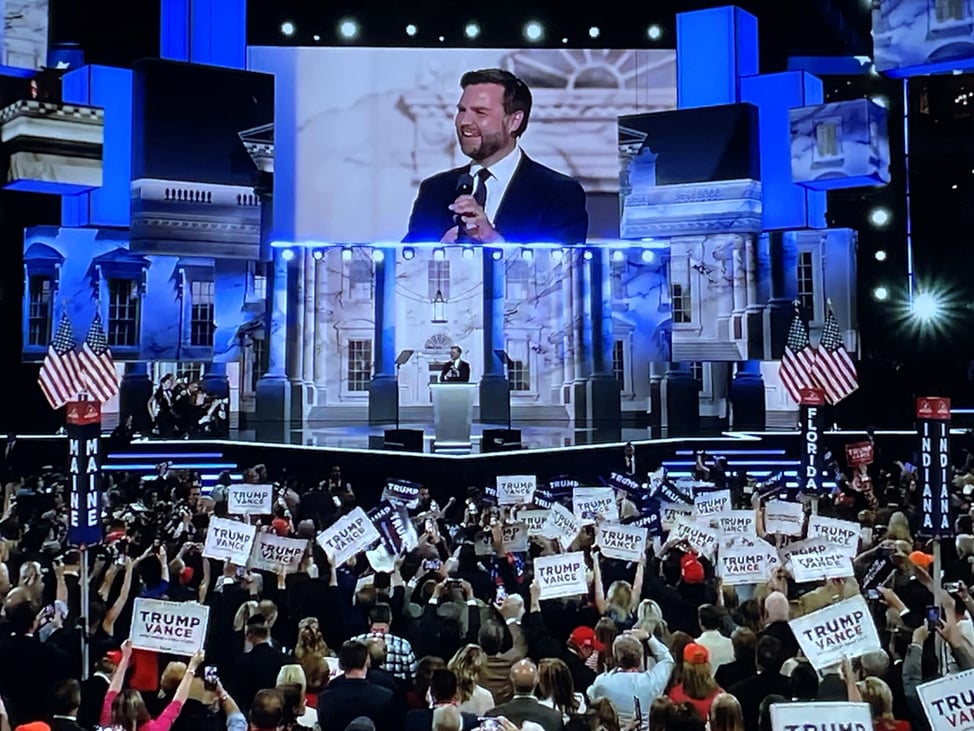
While running for Senate in 2022, now-Vice President JD Vance initiated the challenge to campaign contribution limits that political parties can spend in coordination with a candidate. Two Republican Party committees and former Representative Steve Chabot joined him. But neither Vance nor Chabot are running for office now, and the vice president’s lack of concrete plans for a 2028 White House run were cited as a reason to toss the dispute.
As Martinez put it, “that flunks Article 3.”
The Federal Election Campaign Act, or FECA, sets limits on donations to political candidates to counter quid pro quo corruption. This includes cash payments and expenditure contributions such as payments directly for advertisements.
Federal law regulates individual and political committee donations to prevent end runs around contribution limits. The national committee of a political party — the National Republican Committee and the Democratic National Committee — are exempt from the standard donation limits of $3,500 per election per candidate and $5,000 per year to any other political committee. Instead, donors can give party committees up to $44,300.
The RNC and DNC also get a special exemption allowing the parties to make expenditures in connection with the general election campaign of a candidate for federal office. Under this provision, the national committees can spend over $32 million for presidential campaigns, around $127,200 on Senate campaigns and $63,600 for most House campaigns.
Along with Vance and Chabot, the National Republican Senatorial Committee, NRSC, and the National Republican Congressional Committee, NRCC, claim the spending caps are a restriction on speech, violating the First Amendment. Congress enacted spending caps to reduce excessive campaign spending, the committees argue, not to stave off quid pro quo corruption.
“By rationing the amount of political speech available to a party in consultation with its candidates, the limits have a ‘stifling effect on the ability of the party to do what it exists to do,’” the committees wrote. “They are the ‘equivalent of prohibiting communication between a coach and quarterback late in a tied game.’”
The Supreme Court has fended off First Amendment challenges to the FECA’s restrictions on individual contributions to political campaigns in Buckley v. Valeo in 1976 and on coordinated expenditures in FEC v. Colorado Federal Republican Campaign Committee II in 2001.
Under Chief Justice John Roberts, however, the Supreme Court has swung in the opposite direction, rejecting restrictions on corporate independent expenditures in Citizens United v. FEC in 2010, aggregate limits for individuals to donate funds to campaigns in McCutcheon v. FEC in 2014, and caps on post-election contributions used to pay back candidates for personal loans made to their own campaigns in FEC v. Ted Cruz for Senate in 2022.
Martinez says the throughline is that limits on independent expenditures cannot stand because they lack coordination with candidates, eliminating the risk of corruption. The FECA’s contribution limits from direct payments and coordinated spending, however, must be upheld because they uniquely risk quid pro quo corruption.
Democrats led by the DNC, participating as an intervenor in the case, say a straightforward application of Colorado II easily solves the dispute.
“Parties’ right to make hundreds of thousands or even millions of dollars of coordinated expenditures per candidate represents a unique advantage in the political landscape, not a unique restriction,” the DNC wrote. “There is no constitutional basis for petitioners’ demand that the court convert that limited right into an unlimited one.”
The Republicans argued that Colorado II isn’t relevant and has already been effectively overruled. Colorado II is a “legal last-man-standing” this court should “knock down.”
Court watchers have been critical of the Supreme Court’s support for conservative causes despite the justices’ insistence that their decisions rise above politics. This case presents a particularly thorny decision for the justices, with Republicans and Democrats on opposing sides of the docket. Partisan divisions also appear in the various amici weighing in on the appeal.
House Speaker Mike Johnson and other Republican leadership members suggest the high court adopt a history and tradition approach to campaign finance jurisprudence similar to the new standard for reviewing gun laws. The Republicans are also supported by think tanks like the Cato Institute and pro-business groups like the Chamber of Commerce, which all cast doubt on concerns about the risk of corruption.
On the other side of the aisle, left-leaning groups supporting Democrats and ethics advocates warn that excessive campaign spending is giving wealthy donors an outsized role in the political process. Senate Democrats offered a sharp rebuke of the Supreme Court’s rulings opening the floodgates to more money in politics.
“This court’s past decisions weakened Congress’ ability to regulate the corrupting influence of money in politics, and wreaked havoc on our political system, causing genuine irreparable harm,” the senators wrote.
The Brennan Center argues that disagreements over campaign finance policy need to be settled in Congress, not the courts. The organization has advocated for the repeal of coordinated spending limits, which was cited by the Republican committees and amici supporting their position. However, the Brennan Center pushed the justices to rule for the Democrats.
“Regulating campaign finance necessitates careful weighing of the need to protect free speech and association, prevent corruption, promote transparency and foster the overall health of our political system,” the Brennan Center wrote. “These are issues elected legislatures are best situated to evaluate.”
Vance and Chabot’s nonexistent campaigns are just one reason cited for why the justices should avoid ruling on the case. Martinez says the NRSC and the NRCC also lack standing to challenge the spending caps because the limits don’t apply to either committee, only the RNC. And neither the former candidates nor the committees face any threat of enforcement under the law because the Trump administration has vowed not to enforce the spending caps.
If the justices were to get past the “mare’s nest” of justiciability issues, Martinez said the court would have to decide to overturn a settled precedent and potentially destabilize campaign-finance and First Amendment law to rule for the petitioners. He argued all that effort might be worthwhile if there was a real controversy at stake, but there isn’t.
“This is not a case like Citizens United, Dobbs, Students for Fair Admissions, or Loper**Bright,” Martinez wrote. “There, the court made tough decisions to overturn precedent when necessary to resolve real-life concrete disputes.”
Martinez advocated for dismissing the case as improvidently granted. Republican petitioners would leave as victors, he argued, because they filed the case to eliminate the chill of the enforcement threat posed to their First Amendment interests. If another administration reversed course and decided to enforce the spending caps at a later time, Martinez said the Republicans could renew their challenge on a clean slate.
The Democratic intervenors might be frustrated by non-enforcement of the caps, Martinez said, but Colorado II would remain on the books as if they prevailed on the merits.
“As for the court: Dismissing this inherently politicized case would vindicate its commitment to restraint, neutrality and staying above politics,” Martinez wrote. “It would reaffirm the court’s preference to ‘refrain from addressing constitutional questions’ when doing so is not ‘necessary.’ It would avoid the risks to stability and the rule of law inherent in overruling precedent. And it would preserve the court’s limited resources for live disputes between adverse parties, just as Article 3 envisions.”
The Supreme Court will hear oral arguments on Tuesday.
Sign up for new weekly newsletter Closing Arguments to get the latest about ongoing trials, major litigation and hot cases and rulings in courthouses around the U.S. and the world.
Feds' flip-flop threatens GOP push to snip campaign finance limits at SCOTUS – Courthouse News